The Ultimate List of Must-Have Multi-Channel Marketing Tools
Learn the key features, benefits, and pros/cons of the top multi-channel marketing tools, and choose the right platforms for your tech stack.
 Rebecca Matias
Rebecca Matias is Callbox's COO with 18 years of experience scaling B2B pipeline through data-driven outbound marketing, lead generation, and sales development.
View full bio of Rebecca Matias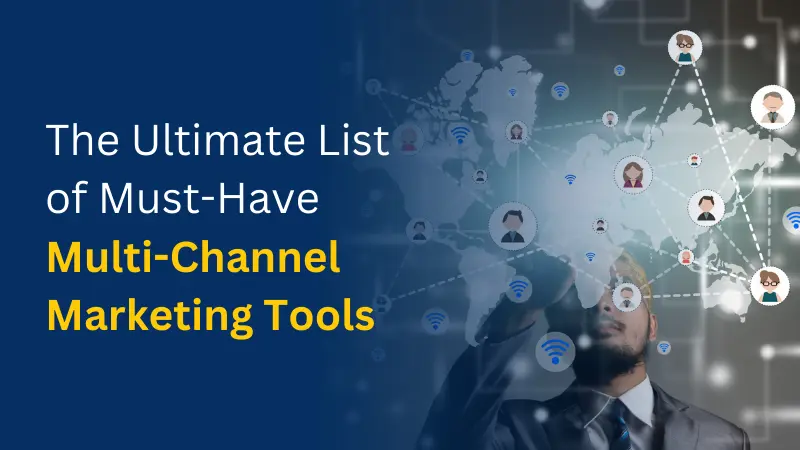
Are you looking to supercharge your marketing strategy? Let’s explore the best tools to help you succeed!
In today’s digital landscape, relying on just one marketing channel is like trying to paddle upstream with one oar—inefficient and frustrating. A robust multichannel marketing platform ensures your brand reaches your audience wherever they are, delivering a cohesive message across multiple touchpoints.
Let’s dive into the top multichannel marketing tools, how they work, and why they’re essential for modern marketers.
Why Multichannel Marketing Matters in 2026
A multi-channel approach doesn’t just improve reach — it compounds results.
Data from Metadata shows that multi-channel campaigns using three or more coordinated channels achieve 287% higher purchase rates compared to single-channel strategies.
Imagine your audience sees your message on social media, then gets a follow-up email, and later receives a personalized SMS. These seamless touchpoints make your brand more memorable and trustworthy. A solid strategy using multi-channel marketing solutions boosts your chances of conversion by engaging your audience across platforms.
The right multichannel marketing platform delivers three core advantages:
- Streamlined campaign management – run email, social, paid, and outbound from one place
- Enhanced personalization – deliver tailored messages based on channel, role, and buying stage
- Automated workflows – trigger the next touchpoint based on real buyer behavior, not a fixed schedule
Now, let’s explore the best tools to implement this approach.
9 Best Multi-Channel Marketing Tools for B2B in 2026
| Tool | Best For | Primary Channels | Complexity |
| HubSpot | All-in-one inbound + CRM | Email, social, content | Low–Medium |
| Apollo.io | Outbound prospecting + sequences | Email, phone, LinkedIn | Medium |
| Clay | Data enrichment + AI workflows | Email, enrichment | High |
| Salesforce MC | Enterprise multi-channel | Email, SMS, social, push | High |
| ActiveCampaign | Nurture automation | Email, SMS, chat | Medium |
| Mailchimp | Quick-start email + social | Email, social ads | Low |
| Zoho Marketing Plus | Budget-conscious all-in-one | Email, SMS, social, events | Medium |
| LinkedIn Marketing | B2B paid + organic reach | Low–Medium | |
| Callbox Pipeline | Fully managed outbound | Email, phone, LinkedIn, social | Managed |
1. HubSpot: All-in-One Platform for Growing Teams
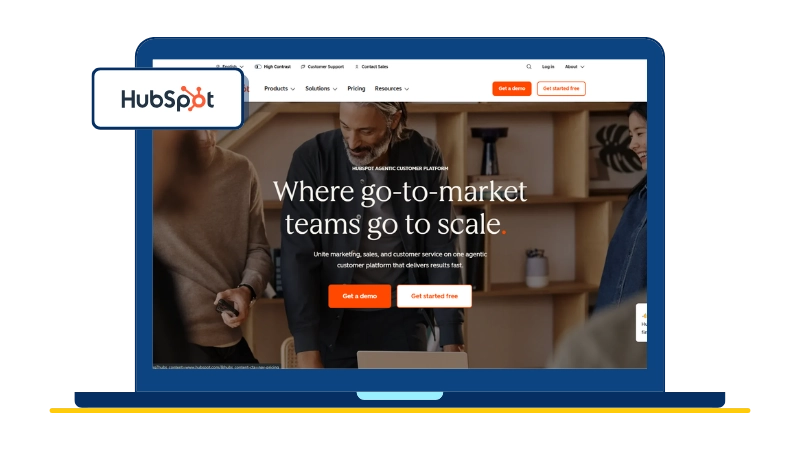
HubSpot’s multichannel marketing platform integrates CRM, email marketing, social media management, automation, and reporting in a single workspace. It allows you to track customer interactions across channels and optimize their journey. In fact, HubSpot is the most widely adopted all-in-one platform among mid-market B2B companies.
Key Features:
- Centralized dashboard for cross-channel campaign management
- Advanced contact segmentation for targeted messaging
- AI-powered content tools and email personalization
- Robust analytics connecting campaign activity to pipeline
Ideal for: Mid-market B2B teams that need a single platform covering inbound marketing, lead nurturing, CRM, and reporting without heavy technical setup.
Pros:
- User-friendly; teams can launch campaigns quickly
- Deep ecosystem of integrations (Salesforce, LinkedIn, Zoom, and 1,000+ more)
- Free CRM tier makes it accessible for smaller teams
Cons:
- Costs escalate quickly at higher contact tiers
- Advanced features (like custom reporting) require higher-tier plans
- Less suited for pure outbound or cold prospecting workflows
Boost your lead generation with multi-channel marketing.
2. Apollo.io: AI-Powered Outbound and Prospecting
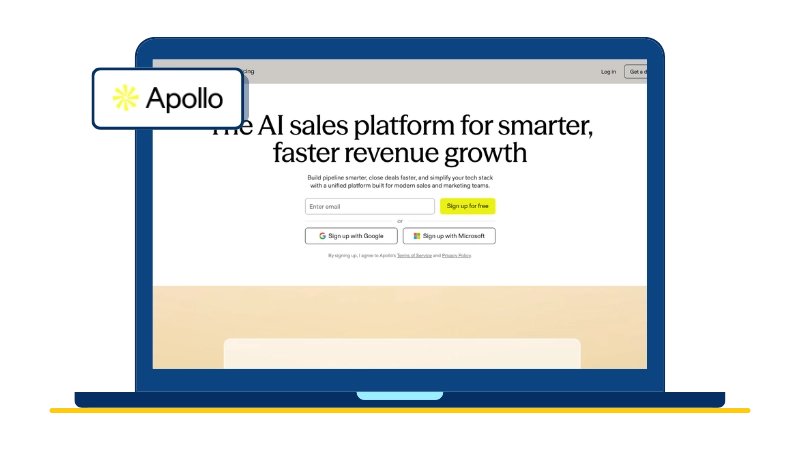
Apollo.io is an AI-powered sales intelligence and engagement platform built specifically for B2B outbound. It combines a database of 230M+ verified contacts with multi-channel sequence automation, a native dialer, and AI-assisted personalization.
Key Features:
- 230M+ verified B2B contacts with 65+ advanced search filters
- Multi-channel sequences across email, phone, and LinkedIn tasks
- AI-powered message writing, lead scoring, and next-best-action recommendations
- Bi-directional CRM sync with Salesforce, HubSpot, and Pipedrive
- Built-in email deliverability tools including inbox warm-up and domain authentication
Ideal for: SDR teams, BDRs, and GTM leaders running structured outbound campaigns who need prospecting data and sequence automation in one platform.
Pros:
- Strong all-in-one value — replaces separate data, outreach, and dialer tools
- Trusted by 2M+ users across 600K+ companies including Anthropic and Autodesk
- Won G2’s 2026 Best Software Award for top AI-native sales intelligence platform
Cons:
- Data accuracy for international contacts and smaller companies can be inconsistent (reported ~65–70% by some users)
- LinkedIn automation is task-based, not fully automated — manual steps required
- Advanced features have a steep learning curve for non-RevOps users
3. Clay: AI-Native Data Enrichment and GTM Workflow
Clay is a data orchestration platform that connects 150+ B2B data providers, AI research agents, and your existing GTM stack into automated enrichment and outreach workflows. It’s become the backbone of modern outbound stacks for RevOps and growth teams.
Key Features:
- Waterfall enrichment across 150+ data providers — achieving 96% email find rate and 1.4% bounce rate on US mid-market ICPs
- Claygent: an AI research agent that autonomously investigates websites, LinkedIn profiles, job postings, and news to build hyper-personalized outreach context
- Clay Sequencer for email outreach with AI personalization at scale
- Real-time buying signal monitoring: job changes, funding rounds, hiring trends, social activity
- Native integrations with HubSpot, Salesforce, LinkedIn Sales Navigator, and MCP connections to Claude and ChatGPT
Ideal for: RevOps teams, SDR managers, and growth engineers running large-scale, data-heavy outbound who need precision enrichment and AI-driven personalization. Best suited to teams with ACVs above $20K and a dedicated RevOps owner.
Pros:
- Best-in-class data accuracy through multi-source waterfall logic
- Claygent dramatically reduces manual research time — Canva saved 4 hours per rep per week using Clay’s automated contact sourcing
- Used by OpenAI, Anthropic, Notion, Intercom, and Mistral AI
Cons:
- Complex setup — most teams need 2–6 weeks to reach production-ready workflows
- Pricing ($149–$800+/month) requires high ACV to justify ROI
- Overkill for very small teams or solo founders without RevOps support
Ready to turn prospects into sales leads in a short time?
4. Salesforce Marketing Cloud: Enterprise-Scale Orchestration
Salesforce Marketing Cloud is the enterprise standard for large organizations managing complex, multi-channel marketing programs across email, SMS, push notifications, social, and advertising, all powered by its Einstein AI.
Key Features:
- Cross-channel campaign management from a single platform
- Einstein AI for predictive analytics, audience segmentation, and send-time optimization
- SMS and push notification capabilities alongside email and social
- Deep integration with Salesforce CRM and Sales Cloud
Ideal for: Enterprise B2B organizations with large contact databases, complex customer journeys, and existing Salesforce infrastructure.
Pros:
- Industry-leading scalability and data governance
- Unified customer view across all channels and touchpoints
- Strong compliance and security framework for regulated industries
Cons:
- High cost; one of the most expensive platforms in the category
- Implementation complexity requires dedicated admin or consulting resources
- Can be overkill for companies without existing Salesforce ecosystem
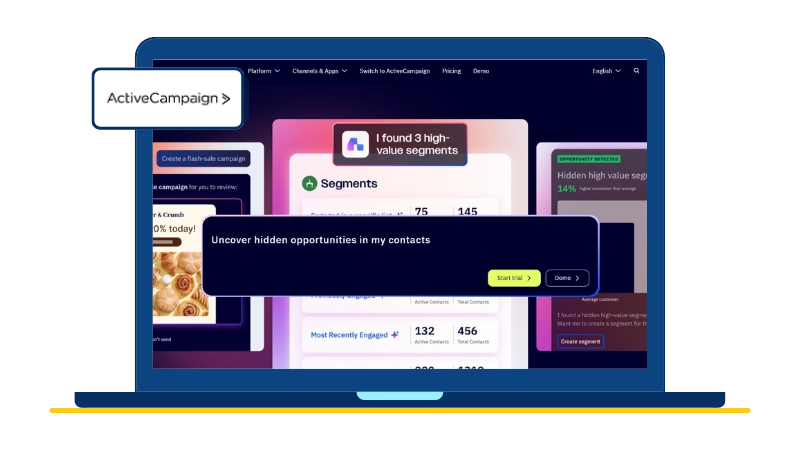
5. ActiveCampaign: Customer Experience Automation
ActiveCampaign combines email marketing, automation, and CRM into one platform. It’s a favorite for those who want to focus on relationship-building while automating repetitive tasks.
Key Features:
- Dynamic content personalization
- Email, SMS, and chat integration
- Customer experience automation workflows
- Visual automation builder
- Lead scoring
Best for: B2B teams focused on lead nurturing and customer lifecycle automation who want granular personalization without enterprise-level complexity or cost.
Pros:
- Best-in-class automation flexibility for mid-market teams
- Strong segmentation and personalization capabilities
- More affordable than HubSpot at comparable feature depth
Cons:
- Reporting and analytics less robust than HubSpot or Salesforce
- CRM functionality is lighter than dedicated platforms
- Steeper learning curve than simpler email tools
6. Mailchimp: Getting Started Quickly
Though famous for its email marketing capabilities, Mailchimp has evolved into a comprehensive multichannel marketing tool. It’s perfect for businesses looking for a user-friendly interface and flexible plans.
Key Features:
- Drag-and-drop email builder
- Social media ad integration
- Tools for creating landing pages and pop-up builders
- Pre-built automation journeys
Ideal for: Early-stage B2B teams and small businesses that need to launch campaigns quickly with minimal technical setup and a low-cost entry point.
Pros:
- Generous free plan for up to 500 contacts
- Extremely easy to use — minimal training required
- Fast time-to-first-campaign
Cons:
- Limited advanced automation compared to ActiveCampaign or HubSpot
- Less suited for complex B2B workflows or large contact databases
- Outgrown quickly as teams scale
7. Zoho MarketingHub: For Budget-Conscious Teams
Zoho’s marketing suite offers everything you need to manage and execute a multichannel marketing platform. From email and SMS to social media, it’s built for businesses seeking a cost-effective solution.
Key Features:
- Drag-and-drop campaign builder
- Social media scheduling and analytics
- Lead nurturing and scoring tools
Ideal for: Small to mid-sized B2B teams already in the Zoho ecosystem, or budget-conscious teams that need broad channel coverage without enterprise pricing.
Pros:
- Highly affordable compared to HubSpot and Salesforce
- Broad feature set across multiple channels in one platform
- Strong native Zoho integrations for teams using Zoho CRM
Cons:
- Less polished UX than HubSpot or Mailchimp
- Community and third-party integration ecosystem smaller than competitors
- Some features lag behind dedicated tools in depth
8. LinkedIn Marketing Solutions: For Reaching B2B Decision-Makers
LinkedIn Marketing Solutions is the advertising and organic content platform within LinkedIn, the world’s largest professional network and the dominant channel for B2B audience reach and engagement.
Key Features:
- Sponsored Content, Message Ads, Conversation Ads, and Lead Gen Forms
- Targeting by job title, seniority, company size, industry, skills, and more
- LinkedIn Sales Navigator for account and contact intelligence
- Campaign Manager with full-funnel analytics and conversion tracking
Ideal for: B2B teams targeting specific professional personas, where LinkedIn’s professional targeting is unmatched.
Pros:
- Unmatched B2B audience targeting precision
- Lead Gen Forms reduce friction; top-performing campaigns benchmark above 10% completion rate
- 87% of B2B companies maintain a paid relationship with LinkedIn (Forrester)
Cons:
- Higher cost per lead than most other digital channels
- Organic reach requires consistent, high-quality content investment
- Limited retargeting capabilities compared to Google or Meta
9. Callbox Pipeline: Fully Managed Multi-Channel B2B Outreach
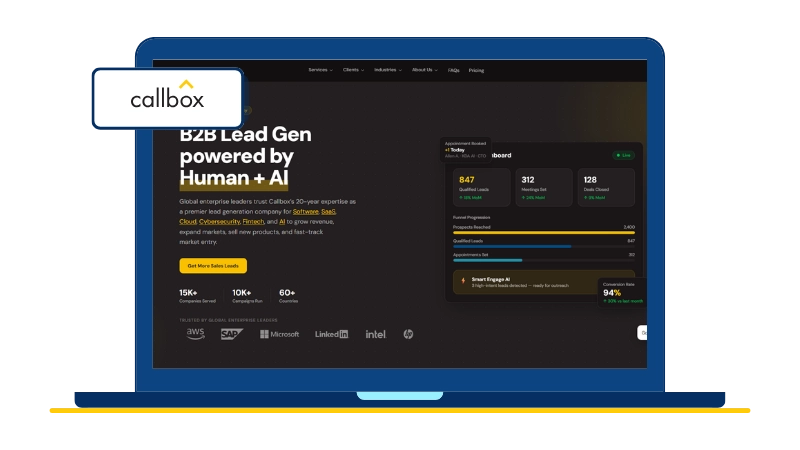
Callbox Pipeline is Callbox’s proprietary multi-channel lead management platform, combining CRM, marketing automation, and a built-in power dialer with human + AI-powered SDR execution across email, phone, LinkedIn, and content.
Key Features:
- Multi-touch campaign management across 6 channels: email, phone, LinkedIn, social media, web, and direct mail
- AI-assisted lead scoring and contact prioritization
- Real-time pipeline visibility with lead status tracking and handoff management
- 45M+ verified global B2B contact database
Ideal for: B2B companies that want a fully managed multi-channel outbound program — without building the internal team, tools stack, or data infrastructure from scratch.
Pros:
- Done-for-you execution — Callbox manages SDRs, data, and campaign coordination
- 20+ years of multi-channel campaign experience across 20K+ campaigns
- Particularly strong for APAC market entry and cross-border campaigns
Cons:
- Not a self-serve tool — designed for outsourced or co-managed programs
- Better suited to companies with defined ICPs and minimum deal sizes
See how Callbox's multi-channel approach generates qualified pipeline
What do you want to learn?
How to Choose the Right Multichannel Marketing Tool
The right multi-channel marketing stack depends on three variables: your buyer journey, your team’s technical capability, and your go-to-market motion.
Use these questions to evaluate each tool:
- Which channels do your buyers actually use? Map tools to where your ICP spends time, not where you’re comfortable.
- What’s your primary motion — inbound or outbound? HubSpot and Zoho skew inbound; Apollo and Clay skew outbound.
- How technically resourced is your team? Clay requires RevOps expertise. Mailchimp requires almost none.
- What does your tech stack already include? Avoid duplication — the best tools integrate with what you have.
- What’s your ACV? High-ACV enterprise sales justify higher-cost platforms. Sub-$5K ACV requires leaner stacks.
The Future of Multichannel Marketing
As marketing evolves, integrating channels will be more critical than ever. Tools that offer automated multi-channel marketing will lead the way, helping you create cohesive and engaging campaigns effortlessly.
Don’t just meet your audience where they are—anticipate their needs and be one step ahead.
Start exploring these tools today and unlock the full potential of multichannel marketing solutions for a successful strategy!
Frequently Asked Questions About Multi-Channel Marketing Tools
What are multi-channel marketing tools?
Multi-channel marketing tools are software platforms that enable businesses to plan, execute, and track campaigns across multiple channels — including email, social media, phone, paid advertising, and content — from a centralized workspace. They eliminate data silos, automate workflows, and help teams deliver consistent messaging across every buyer touchpoint.
What is the best multi-channel marketing platform for B2B?
The best multi-channel marketing platform for B2B depends on your go-to-market motion. For inbound and lead nurturing, HubSpot leads the category. For outbound prospecting, Apollo.io and Clay are the strongest options in 2026. For enterprise-scale orchestration, Salesforce Marketing Cloud is the standard. Most mid-market teams benefit from combining two or three tools rather than relying on one.
What is the difference between multi-channel and omnichannel marketing?
Multi-channel marketing means reaching customers across multiple channels independently. Omnichannel marketing means those channels are fully integrated and share data in real time, so the buyer experience is seamless and consistent regardless of which channel they use. Most modern B2B platforms aim for omnichannel coordination, though few fully achieve it.
What is automated multi-channel marketing?
Automated multi-channel marketing uses software to trigger outreach across channels based on buyer behavior rather than a fixed schedule. For example, when a prospect visits your pricing page, an automated workflow might send a follow-up email, add a LinkedIn connection task for the SDR, and trigger a targeted ad — all without manual intervention.
How many channels should a B2B marketing stack cover?
Research shows that multi-channel campaigns using three or more coordinated channels achieve 287% higher purchase rates than single-channel strategies. However, more channels don’t automatically mean better results — the key is choosing channels where your buyers are active and orchestrating them with consistent, context-aware messaging.