Data Management Software Leads That Actually Close
Turn interest into revenue with targeted data management software leads. Connect with marketing and IT leaders searching for smarter data management.

Buying a lead list is one of the most expensive things a B2B company can do — not because of the price tag, but because of what it signals: that you don’t trust the data you already have.
That’s a costly assumption. Companies that shift budget away from purchased lists and toward activating their own data management solutions consistently report lower cost-per-acquisition, higher conversion rates, and stronger compliance standing. The leads were never missing. The infrastructure to surface them was.
If you’re still treating data management software leads as a byproduct of your CRM hygiene routine rather than as a primary pipeline source, this article will reframe how you think about where your best opportunities actually live.
Struggling on how to overcome business challenges and slow pipeline?
At a Glance
This article makes the case that the leads your team needs are already inside your existing data — they just aren’t being activated. We will walk through why the true cost of a purchased lead list runs far higher than its price tag, and how to run a Demand Signal Audit to uncover pipeline hiding in your own database.
We will cover the compliance and deliverability risks that make list buying increasingly dangerous. The discussion will also include the three infrastructure gaps that keep most internal data idle, and five data management platforms worth evaluating for B2B pipeline activation.
We will also show how Callbox turns your existing data into qualified meetings and closed revenue, take you through a step-by-step Pipeline Recovery Cycle to move from list dependency to a data-first growth model, and lay out the three metrics that make internal data performance visible to leadership.
The Real Cost of a Lead List Nobody Is Calculating
Most sales operations calculate lead list cost as price per contact. That is the wrong number. The number that actually matters is cost per qualified conversation, and when you run it honestly, purchased lists rarely win.
Consider a standard scenario: you pay $0.50 per contact for a list of 5,000 records. On delivery, 20% to 35% of those contacts have outdated information, the wrong job title, or no longer work at the company listed. Of the remaining records, your team reaches roughly 10 percent through cold outreach. Of those, a fraction are actually in-market.
The true cost per booked meeting can easily exceed $400 to $600, before you account for the sales rep time spent on dead-end dials. HubSpot’s CPL benchmarks confirm that B2B cost-per-lead averages vary widely by channel, but purchased list outreach consistently ranks among the least efficient paths to pipeline.
Now run the same math on a contact that already exists in your database management system, one who has visited your pricing page, opened three emails, and fits your ideal customer profile exactly. The outreach cost is near zero. The conversion rate is dramatically higher. The compliance risk is lower because you have a documented relationship with that contact.
Ready to meet new opportunities for your data management business?
What Your Data Management Software Leads Are Actually Telling You
Your database management system is not a storage tool. It is a signal engine. Every contact record, every interaction timestamp, every enrichment update is a data point that tells you something about buying intent, relationship warmth, and fit. Most organizations treat these signals as administrative noise.
The companies that outperform on pipeline efficiency do the opposite. According to Content Marketing Institute’s 2025 B2B research, nearly half of B2B marketers say they lack streamlined marketing data management and reporting — confirming that the gap is not in data availability, but in how that data is structured and used. They run what can be called a Demand Signal Audit, a structured review of their existing data assets to identify three categories of leads that are hiding in plain sight.
The Demand Signal Audit: Three Lead Categories in Your Existing Data
- Dormant Qualified Contacts — past leads that met ICP criteria but did not convert, often due to timing rather than fit.
- Engaged Non-Converts — contacts who interacted with content, attended webinars, or opened sequences but never entered a formal sales motion.
- Expansion Signals — existing customers or past customers whose firmographic data suggests they are now eligible for upsell, cross-sell, or re-engagement.
A well-configured data management solution can surface all three categories automatically. The catch is that most CRM and data management setups are not configured to do this work. The data exists. The logic to act on it does not.
Why Purchased Lists Are Getting More Dangerous, Not Just More Expensive
The compliance argument against lead lists has never been stronger. GDPR, CCPA, and the expanding patchwork of state-level data privacy regulations have changed the legal exposure profile of outreach to contacts you did not organically acquire. When you buy a list, you are inheriting whatever consent framework the vendor used, which is often opaque and difficult to audit.
Your internal data, by contrast, has a documented origin. You know when and how each contact entered your system. That traceability is a compliance asset that purchased lists simply cannot match, and regulators are increasingly treating it as a requirement rather than a best practice. MarketingProfs notes that B2B marketers must ensure lead data was captured willingly and legally — heightened global concerns around data privacy have led to new laws that place real limits on how businesses collect and use audience data.
Beyond compliance, there is a deliverability and reputation dimension. Outreach to stale or non-consensual contacts damages your sending domain, raises spam complaint rates, and degrades the performance of every future campaign you run. The short-term volume of a list purchase often erodes the long-term deliverability of your entire outbound operation. Salesforce’s State of Sales report found that only 35% of sales professionals completely trust the accuracy of their organization’s data — a figure that drops even further when that data originates from external vendors with unknown sourcing standards.
The Three Infrastructure Gaps Keeping Your Data Inactive
If your internal data is so valuable, why isn’t it generating pipeline already? In most organizations, three specific infrastructure failures are responsible.
Gap 1: Enrichment Is Treated as Onboarding, Not Ongoing
Most teams enrich contact data when it enters the system and never again. Job titles change. Companies get acquired. Decision-makers move. A contact that was perfectly accurate 18 months ago may now be completely wrong. LinkedIn’s 2024 B2B Marketing Benchmark highlights that data-driven targeting is no longer optional for competitive B2B marketers — making continuous enrichment a strategic necessity rather than a maintenance task. Data management solutions that automate continuous enrichment, pulling updated firmographic and contact data from sources like ZoomInfo or Clearbit, keep your internal list as fresh as anything a vendor would sell you.
Gap 2: Segmentation Logic Is Too Broad to Be Actionable
Telling your sales team that their territory is “mid-market SaaS companies in North America” is not a list. It is a category. Effective data management translates that category into a dynamic, prioritized segment built on fit score, engagement history, and intent signals. Without this layer, reps default to the path of least resistance, which is often a purchased list that someone else has already segmented for them.
Gap 3: There Is No Activation Workflow Connected to the Data
Data management software is not a leads tool by default. It becomes one when you connect it to an activation layer, a set of workflows that automatically move high-signal contacts into sales sequences, assign them to reps, or trigger personalized outreach based on behavior. Without that connection, even perfect data sits idle.
Related: 10 Managed Cloud Trends for 2026
The Data Management Software and Tools Worth Knowing
Not every platform handles the data-to-pipeline workflow equally. Here are five worth evaluating based on your stage and use case.
1. Salesforce Data Cloud
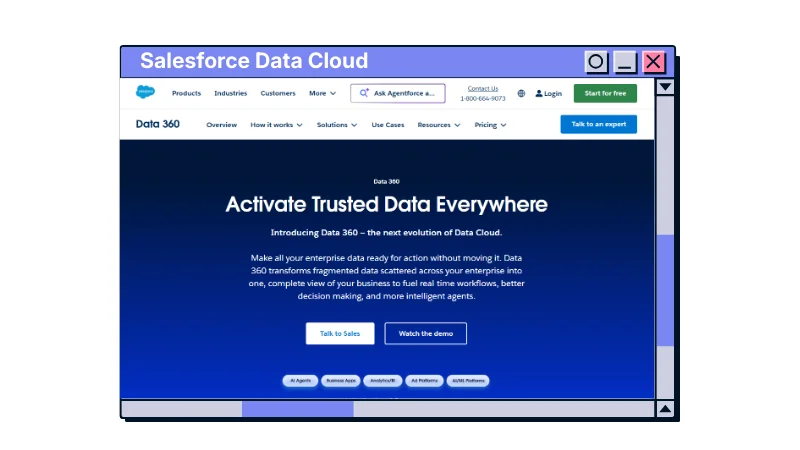
Unifies customer data across sources into a single profile. Distinct for its ability to resolve identities across channels and power real-time segmentation at enterprise scale.
2. HubSpot Operations Hub
Automates data sync, cleaning, and quality workflows inside the HubSpot ecosystem. Best suited for SMB and mid-market teams already on HubSpot who want to eliminate manual data hygiene.
3. ZoomInfo
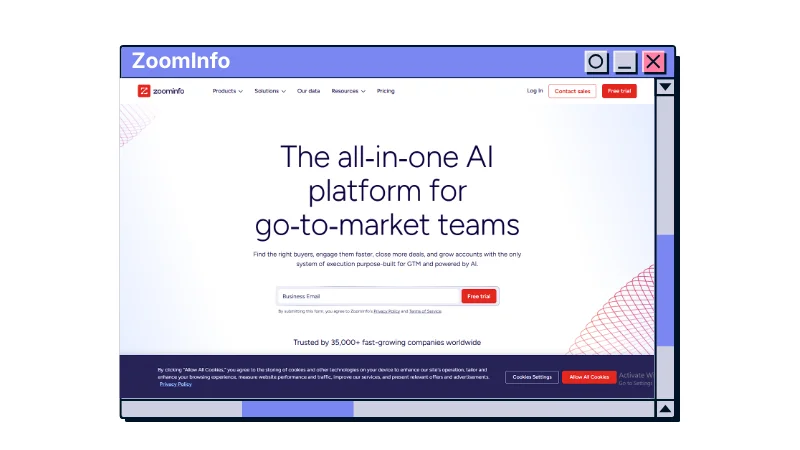
A B2B contact and intent data platform that can continuously enrich your existing records with current firmographic and contact information. Distinct for its combination of contact accuracy and buyer intent signals.
4. Segment
A customer data platform that collects behavioral data from web, mobile, and product surfaces and routes it into your CRM or data warehouse. Best for teams whose best leads are already interacting with their digital properties.
5. Snowflake
A cloud data platform that serves as the foundation for enterprise-grade data management solutions, enabling teams to query, segment, and activate data at scale without moving it between systems.
Related: Top Cloud Software Companies
Where Callbox Fits Into a Data-First Pipeline Strategy
Activating internal data is a structural advantage. But structure alone does not close deals. At some point, qualified contacts need to be engaged, converted, and nurtured into lasting revenue relationships, and that is where many data-rich organizations still stall.
Callbox accelerates revenue by engaging prospects after brand awareness and converting them into qualified meetings, closed deals, and loyal customers. Once customers are acquired, Callbox does not stop. Callbox then nurtures them into repeat business, advocacy, referrals, and expansion opportunities, feeding revenue back into the top of the funnel. This creates a self-reinforcing growth engine that continuously scales pipeline, accelerates sales, and maximizes customer lifetime value.
This model consistently outperforms the list-buy approach because both inputs are higher quality. The data is more accurate. The outreach is more targeted. And because Callbox’s model is built around the full customer lifecycle rather than one-time acquisition, the revenue generated compounds over time rather than expiring with a single campaign.
How to Start: A Practical Activation Framework
Moving from list dependency to data activation does not require a platform overhaul. It requires a process change. Here is a practical starting point structured around what can be called the Pipeline Recovery Cycle.
The Pipeline Recovery Cycle
Step 1: Audit — Run a Demand Signal Audit on your existing database management system. Identify dormant qualified contacts, engaged non-converts, and expansion signals.
Step 2: Enrich — Connect a continuous enrichment tool to update job titles, company data, and contact accuracy. Focus on the top 20% of records by fit score.
The goal of this cycle is not to eliminate all outside data sourcing forever. It is to establish your internal data as the primary pipeline driver and treat outside sources as supplements rather than defaults.
Step 3: Segment — Build dynamic segments based on ICP criteria plus engagement signals. Avoid static lists. Segments should update automatically as data changes.
Step 4: Activate — Connect segments to outreach workflows. Assign high-priority contacts to rep sequences. Use automation for lower-priority tiers.
Step 5: Measure — Track cost per qualified conversation, not just cost per contact. Compare this to your last list purchase to quantify the delta.
The Measurement Shift That Makes This Work Visible
One reason teams keep buying lead lists is that the cost is visible and the return is easy to report. A $5,000 list purchase produces a line item with an obvious number attached. The value of your existing data is harder to see because no one is measuring it.
The fix is to add three metrics to your pipeline reporting that make internal data performance visible.
• Data-Sourced Pipeline Value: the total value of opportunities that originated from internal data segments rather than purchased lists or inbound forms.
• Contact Decay Rate: the percentage of your database that becomes inaccurate or unreachable each quarter. This number makes the case for continuous enrichment better than any vendor pitch.
• Reactivation Conversion Rate: the percentage of dormant qualified contacts that convert to active opportunities when re-engaged. This metric alone often justifies the entire shift to a data-first model.
When these numbers are visible, the conversation about lead list spend changes fast. It is no longer a debate about strategy. It is a comparison of measurable returns. HubSpot’s State of Marketing research reinforces this: B2B teams that use data to drive pipeline decisions consistently outperform those running on instinct or inherited vendor relationships.
The Opportunity Is Already in Your System
The next time someone on your team proposes a lead list purchase, ask one question before approving it: have we fully activated the data we already own?
In most organizations, the answer is no. The contacts exist. The signals are there. The infrastructure to surface and act on data management software leads is either underconfigured or disconnected from sales. Fixing that is a one-time structural investment that pays compounding returns. Buying a list is a recurring cost that resets to zero after every campaign.
The companies winning on pipeline efficiency in 2024 and beyond are not the ones buying the most data. They are the ones getting the most out of the data they already have. Start there.
Frequently Asked Questions
Is it worth buying lead lists for B2B sales?
Purchased lead lists can generate volume quickly, but they consistently underperform internal data on conversion rate, compliance standing, and cost per acquisition. For most mid-market and enterprise B2B companies, activating existing data through better data management software produces a higher return than buying net-new contact lists.
What is a Demand Signal Audit and how do I run one?
A Demand Signal Audit is a structured review of your existing contact and account data to identify leads that already meet your ideal customer profile but have not been actively worked. You run it by segmenting your database management system into three categories: dormant qualified contacts, engaged non-converts, and expansion-eligible accounts. Then you apply current ICP criteria and engagement thresholds to prioritize outreach. The goal is to generate a workable pipeline list without purchasing a single new contact.
Are purchased lead lists legal under GDPR and CCPA?
Using purchased lead lists for outreach can create compliance exposure under GDPR, CCPA, and other privacy regulations, depending on how consent was obtained and documented by the vendor. Internal data with clear consent and documented origin generally carries lower compliance risk. Before purchasing any list, you should verify the vendor’s consent framework and consult legal counsel on how outreach to those contacts aligns with applicable regulations in your target markets.
What is the best database management system for B2B lead generation?
There is no single best database management system for B2B lead generation because the right choice depends on your existing tech stack, data volume, and team capabilities. For teams prioritizing contact enrichment and intent signals, ZoomInfo integrates well with most CRMs. For teams that need to unify behavioral and firmographic data at scale, Salesforce Data Cloud or Segment are strong options. The most important factor is not the platform itself but whether you have activation workflows that connect your data to sales outreach.
Can I use my own data with an outsourced lead generation partner?
Yes, and it is often the most effective approach. Outsourced lead generation partners that support data-first workflows, like Callbox, can take your existing contact database, apply qualification criteria, and run structured outreach against it. This combines the accuracy of your internal data with the outreach infrastructure and scale of a dedicated sales development team. The result is typically faster pipeline velocity and lower cost per meeting than buying new lists and working them in-house.
How do I measure the ROI of internal data versus purchased lead lists?
Compare three metrics side by side: cost per qualified conversation, pipeline conversion rate, and average deal size. Run both sources through the same outreach motion for a defined period, then measure outcomes rather than volume. Internal data consistently produces higher conversion rates and lower cost per meeting in most B2B contexts, but the advantage becomes undeniable only when you track it explicitly rather than assuming the list purchase is working because it generated raw activity.