2025 MSP Trends That Will Double Your Revenue
From the rise of consultation services to the demands in cybersecurity, we take a look at the B2B market trends for managed services (MPS).


The managed services industry is entering 2025 at full speed, with market demand reaching unprecedented levels. Yet, for many MSP providers, rapid growth also comes with mounting challenges.
According to recent forecasts, the global MSP market growth is expected to surpass $350 billion in 2025, but the question is, how can your MSP claim a larger share of this booming market?
In this blog, we’ll explore the key managed services trends that will drive growth, along with the challenges you must navigate. Whether you want to generate MSP leads, expand your reach through a multichannel approach, or strengthen your MSP business with outsourced sales support, these insights will help you adapt, innovate, and thrive.
MSP Market Outlook for 2025
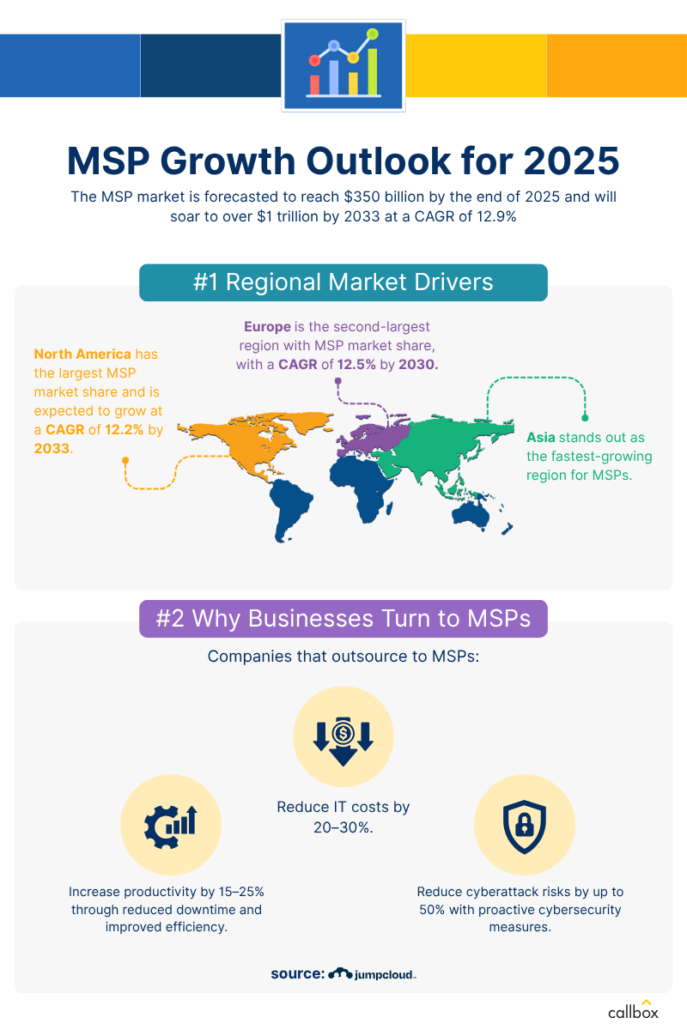
The MSP market growth trajectory is stronger than ever. With digital transformation, cybersecurity demand, and hybrid cloud adoption fueling the industry, the stage is set for unprecedented expansion.
Recent reports forecast the global MSP market to reach $350 billion in 2025, with further growth to over $1 trillion by 2033, representing a 12.9% CAGR.
Regional Market Drivers
- North America continues to dominate, with the U.S. driving the highest demand and projected to grow at a 12.2% CAGR.
- Europe follows closely with a projected 12.5% CAGR by 2030, fueled by the region’s push for data compliance and cloud adoption.
- Asia-Pacific stands out as the fastest-growing market, with China investing heavily in digital infrastructure, India’s BFSI sector rapidly adopting cloud solutions, and Japan expanding its advanced manufacturing and service sectors.
Why Businesses Turn to MSPs
Across industries, organizations are choosing MSPs not only to cut costs but to enhance productivity and security. Research shows that companies outsourcing to MSPs can:
- Reduce IT costs by 20–30%.
- Increase productivity by 15–25% through reduced downtime and improved efficiency.
- Reduce cyberattack risks by up to 50% with proactive cybersecurity measures.
This strong value proposition explains why nearly 90% of SMBs already use or are considering an MSP, with many large enterprises also outsourcing IT and cloud services for scalability and risk reduction.
Challenges Facing MSPs in 2025
While the growth outlook for managed services is undeniably strong, MSP providers must also navigate a set of critical challenges that could impact profitability and long-term success. Understanding these hurdles is key to positioning your business for growth and ensuring you’re not left behind as competition heats up.
1. Fierce Competition and Market Saturation

With more providers entering the space, the MSP market is becoming increasingly crowded. High-performing MSPs are pulling ahead by focusing on Average Revenue Per User (ARPU) and staff efficiency, but many providers struggle to differentiate their offerings.
Industry consolidation is also accelerating, with larger MSPs acquiring smaller players to expand capabilities and market share.
2. Talent Shortages in IT and Cybersecurity
Finding and retaining skilled professionals remains a pressing concern. As demand for advanced IT and cybersecurity expertise rises, MSPs are battling a limited talent pool.
Those that fail to address this gap risk overburdening their teams and compromising service quality. Moreover, many MSPs underutilize key financial metrics like the ratio of service cost to wages, making it difficult to properly price services and manage staffing costs.
3. The Escalating Cybersecurity Threat

Cybersecurity remains the top challenge driving organizations to partner with MSPs, with 60% of businesses citing it as their primary concern.
Attackers are becoming more sophisticated, and compliance standards are growing stricter. MSPs that cannot provide advanced security frameworks, including threat detection, compliance support, and proactive risk management, risk losing clients to better-prepared competitors.
4. Complex and Fragmented Technology Stacks
Many MSPs are grappling with sprawling tech stacks that complicate service delivery and increase overhead. While AI and automation offer opportunities to streamline operations, adopting and integrating new tools is not without its challenges. You must strike the right balance between leveraging innovative technologies and maintaining cost efficiency.
5. Client Retention and Satisfaction Gaps

Although recurring revenue remains a major driver of MSP growth, many providers still lack comprehensive client success programs. Without strong retention strategies and consistent measurement of key metrics like Customer Lifetime Value (CLTV) and churn rates, your MSP business risks losing clients and missing out on the compounding benefits of long-term relationships.
6. Profitability and Margin Pressures
Even as revenues climb, margins remain under pressure due to rising labor costs, technology investments, and competitive pricing.
Alarmingly, it is said that fewer than 20% of MSPs track EBITDA (Earnings Before Interest, Taxes, Depreciation, and Amortization), a crucial measure of overall company performance, particularly for those seeking outside investment or planning for a future exit.
Top MSP Market Trends Fueling Growth in 2025
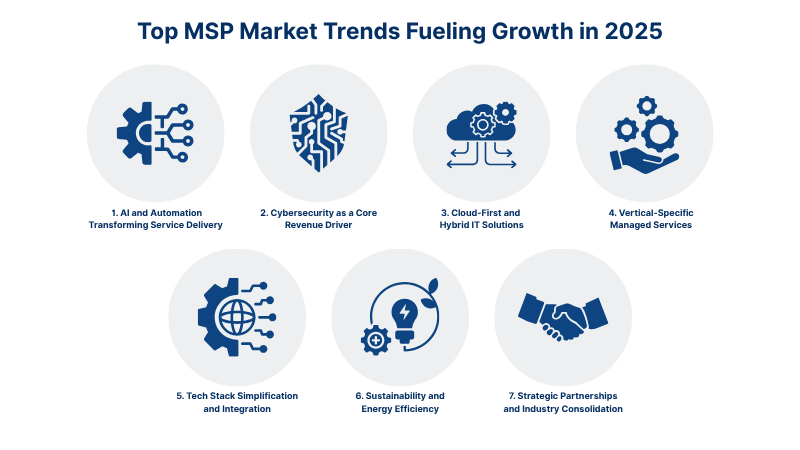
Despite the challenges MSPs face, 2025 offers significant opportunities for providers ready to adapt and innovate. The most successful MSPs will be those who align with these emerging trends, turning obstacles into growth levers and creating a competitive edge.
1. AI and Automation Transforming Service Delivery
MSPs are increasingly adopting AI-powered automation to streamline operations, reduce response times, and provide proactive IT support.
From predictive maintenance to automated ticket resolution, these technologies not only cut costs but also enhance client satisfaction by solving problems before they escalate. Providers who invest in automation can improve staff efficiency, boost ARPU, and scale faster without proportionally increasing headcount.
2. Cybersecurity as a Core Revenue Driver
With 60% of businesses citing cybersecurity as their top IT challenge, MSPs offering advanced security services are positioned for strong growth. In 2025, cybersecurity is no longer a “value-add” but a baseline expectation.
Threat detection, compliance management, and incident response will be bundled into core service packages, providing MSPs with a high-demand, high-margin revenue stream.
3. Cloud-First and Hybrid IT Solutions
The demand for cloud migration, hybrid IT, and remote workforce enablement continues to surge. With 60% of large organizations already outsourcing cloud management to MSPs, providers who specialize in hybrid infrastructure and multi-cloud environments will gain a competitive advantage. Offering seamless integration and ongoing optimization will be critical to retaining clients in this fast-evolving landscape.
4. Vertical-Specific Managed Services
A growing number of MSPs are moving away from one-size-fits-all solutions and tailoring their services for specific industries such as healthcare, finance, and manufacturing.
For example, the manufacturing sector is leveraging Big Data and Industry 4.0 technologies to optimize production, while the BFSI sector in Asia is rapidly adopting cloud and security solutions. Specialization not only boosts margins but also builds long-term client loyalty.
5. Tech Stack Simplification and Integration
Complex tech stacks are driving up costs and complicating service delivery. In 2025, MSPs will focus on simplifying and consolidating their technology stacks to improve efficiency and reduce overhead. Consolidation will also drive better vendor partnerships and streamlined client experiences.
6. Sustainability and Energy Efficiency
As clients grow more eco-conscious, MSPs are embracing green IT practices, including energy-efficient data centers and cloud optimization. This not only meets corporate social responsibility goals but also appeals to clients looking to reduce operational costs and carbon footprints simultaneously.
7. Strategic Partnerships and Industry Consolidation
Industry consolidation continues to shape the MSP landscape, with larger providers acquiring smaller firms to expand their service portfolios. At the same time, strategic vendor partnerships are helping MSPs integrate more comprehensive solutions, from cybersecurity to IoT management. For providers of any size, forming the right alliances will be key to staying competitive.
Key Takeaways for MSP Providers
The outlook for 2025 is undeniably bright for managed service providers. Still, capturing that growth requires more than just keeping pace; it demands proactive strategy, innovation, and a sharp focus on client value.
Here’s what MSPs need to prioritize this year:
1. Turn Challenges Into Growth Opportunities
Rising competition, talent shortages, and profitability pressures aren’t obstacles— they’re signals to refine your model. By adopting AI-powered automation, simplifying your tech stack, and investing in client success programs, you can boost efficiency and retention while maintaining margins.
2. Double Down on Cybersecurity and Cloud Services
With cybersecurity ranked as the top concern for 60% of businesses and cloud adoption accelerating worldwide, MSPs that strengthen these offerings will stand out as trusted partners and revenue leaders.
3. Specialize to Differentiate
Tailoring your services to high-growth verticals like healthcare, finance, or manufacturing positions your MSP as an expert, commands higher margins, and fosters long-term client loyalty.
4. Leverage Partnerships and Marketing to Scale Faster
Forming strategic alliances and investing in multichannel marketing campaigns will help you expand reach and enhance your service portfolio. Working with a trusted partner for MSP lead generation and outsourced sales support can give you the consistent flow of qualified leads needed to accelerate growth without overburdening your team.
Conclusion
The year 2025 marks a pivotal moment for the managed services industry. With the market projected to exceed $350 billion this year and poised to more than double in the coming decade, the opportunities for MSPs have never been greater. Yet, seizing this growth requires more than optimism — it demands strategic action.
By embracing AI-driven automation, fortifying cybersecurity frameworks, simplifying technology stacks, and targeting high-value verticals, MSPs can not only overcome today’s challenges but also build stronger, more profitable client relationships. Those who adapt quickly will emerge as the leaders of this rapidly expanding market.
At Callbox, we understand the unique challenges MSPs face in scaling their businesses. That’s why we specialize in helping providers like you generate MSP leads, acquire more MSP clients, and execute multichannel marketing campaigns that drive measurable results. Whether you need outsourced sales support or a partner to expand your reach, we’ll help you unlock consistent growth in 2025 and beyond.