Best SaaS Sales Tools: From First Lead to Closed-Won
Compare top SaaS sales tools built to improve lead quality, strengthen pipeline performance, and scale revenue growth.


The best SaaS sales tool your team could add right now might not be a tool at all.
That’s not a knock on software. It’s a pattern that keeps showing up in high-performing SaaS sales teams: they invest heavily in the human layer first — outbound prospecting, lead qualification, pipeline coverage — and then let their tech stack serve that motion, not replace it. The teams struggling most are often the ones who bought the tools before they built the process.
This guide doesn’t hand you another undifferentiated list of SaaS sales tools sorted by category. Instead, it maps the best tools available to each stage of your revenue journey — from generating your first qualified SaaS sales leads to closing and expanding accounts — so every tool you add has a clear job to do.
Is your SaaS growth slowing because your outreach strategy isn’t converting prospects?
At a Glance
In this article, we walk through the best SaaS sales tools available today, but we organize them differently from most guides you’ll find. Rather than grouping tools by software category, we structure the entire guide around your revenue journey: generating leads, qualifying pipeline, converting opportunities, and retaining and expanding accounts.
Along the way, we introduce the Revenue-Stage Stack, a framework for deciding which tools belong in your stack and exactly when to deploy them. By the end, you’ll know not just which SaaS sales tools exist, but which ones belong at each stage of your process, what outcomes to expect from each, and how to layer a managed service like Callbox into your stack to accelerate the stages where most teams lose momentum.
Why Your Sales Stack Needs a Revenue Map
Most SaaS sales teams build their stack the same way. They identify a pain point, find a tool that addresses it, and add it to the pile. Over time, the stack grows. Productivity does not always follow.
The reason is structural. Tools purchased by category — CRM, prospecting, outreach, analytics — do not automatically connect. Each tool optimizes its own function without reference to where that function sits in your actual revenue journey. As a result, handoffs break, data stays siloed, and reps spend more time managing tools than closing deals.
The fix is a different organizing principle. Instead of asking “what category is this tool?” ask “what stage of my pipeline does this tool serve?” That shift in thinking is the foundation of what we call the Revenue-Stage Stack.
Related: Strategic SaaS Demand Generation
What Is the Revenue-Stage Stack?
The Revenue-Stage Stack is a framework for building and auditing your SaaS sales tech stack by revenue stage rather than software category. It has four stages: Generate, Qualify, Convert, and Expand. Every tool in your stack should map to one of these stages. If a tool does not serve a specific stage outcome, it does not belong in the stack.
This framework matters because it forces a direct connection between your tools and your pipeline metrics. This framework matters because it forces a direct connection between your tools and your pipeline metrics.
- Generate-stage tools are measured by lead volume and lead quality.
- Qualify-stage tools are measured by conversion rate from lead to opportunity.
- Convert-stage tools are measured by win rate and sales cycle length.
- Expand-stage tools are measured by net revenue retention and expansion revenue.
When each tool has a stage and a metric, your stack becomes accountable. You can see exactly where pipeline is leaking and which tool is responsible for fixing it. Check out the 12 B2B SaaS marketing mistakes to avoid.
Stage 1: Generate — SaaS Sales Leads Tools
The Generate stage is where most SaaS sales teams over-invest in software and under-invest in execution. Data providers and prospecting tools are abundant. Qualified pipeline is not.
The core job of Generate-stage tools is to surface prospects who match your ideal customer profile and get them into an active outreach sequence. The tools in this stage fall into two groups: data and intelligence tools that help you find and prioritize the right prospects, and outreach tools that help you reach them at scale.
What should SaaS sales teams look for in a lead generation tool?
Look for tools that combine contact data quality, intent signals, and workflow integration. A tool that gives you a large database with outdated contacts wastes your team’s time. A tool that surfaces intent signals without accurate contact data gives you nowhere to direct that signal. The best Generate-stage tools do both and push directly into your CRM or sequencing tool.
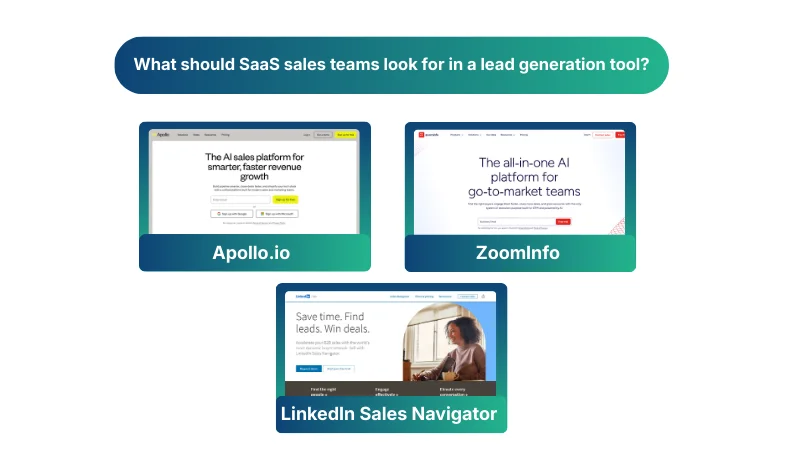
- Apollo.io — A prospecting and outreach platform that combines a large B2B contact database with built-in email sequencing. What makes Apollo distinct is that it handles both data sourcing and outreach in one workflow, removing the need for a separate list-building step. It works well for SaaS sales teams running high-volume outbound.
- ZoomInfo — A data intelligence platform with deep firmographic and technographic filters. ZoomInfo’s edge is intent data: it tracks online research behavior and surfaces accounts actively looking at solutions like yours. For SaaS teams selling into enterprise, the account-level intelligence justifies the cost.
- LinkedIn Sales Navigator — A prospecting tool built on LinkedIn’s professional network. It excels at identifying buying committees and tracking job changes at target accounts, both of which are high-signal triggers for SaaS outbound.
Where Callbox Fits at the Generate Stage
For SaaS sales teams that need pipeline faster than an internal prospecting motion can deliver, outsourcing the Generate stage is a legitimate strategic option. Callbox accelerates revenue by engaging prospects after brand awareness and converting them into qualified meetings, closed deals, and loyal customers. Once customers are acquired, Callbox doesn’t stop. It nurtures them into repeat business, advocacy, referrals, and expansion opportunities, feeding revenue back into the top of the funnel. This creates a self-reinforcing growth engine that continuously scales pipeline, accelerates sales, and maximizes customer lifetime value.
The practical value for SaaS teams is speed. Rather than spending six to twelve months building an outbound motion from scratch, Callbox delivers sales-ready leads directly into the stages that follow. Your internal stack handles qualification and conversion. Callbox handles the pipeline fill.
See the reasons why B2B SaaS Companies choose Callbox.
Stage 2: Qualify — Turning Leads Into Real Opportunities
Generate-stage activity creates volume. Qualify-stage tools determine which of that volume is worth your team’s time.
Qualification is where many SaaS sales teams leak the most revenue. Without structured scoring and routing, high-potential leads sit in the CRM untouched while reps work accounts that will never close. The tools at this stage solve for speed-to-lead, lead scoring accuracy, and clean handoff from marketing to sales.
Does lead scoring software actually improve close rates?
Yes, but only when the scoring model is calibrated to your actual closed-won data. Most teams set up lead scoring at implementation using assumptions about what a good lead looks like, and then never revisit it. The teams that get consistent value from scoring tools are the ones that audit their model quarterly against closed-won and closed-lost deals and adjust the weights accordingly.
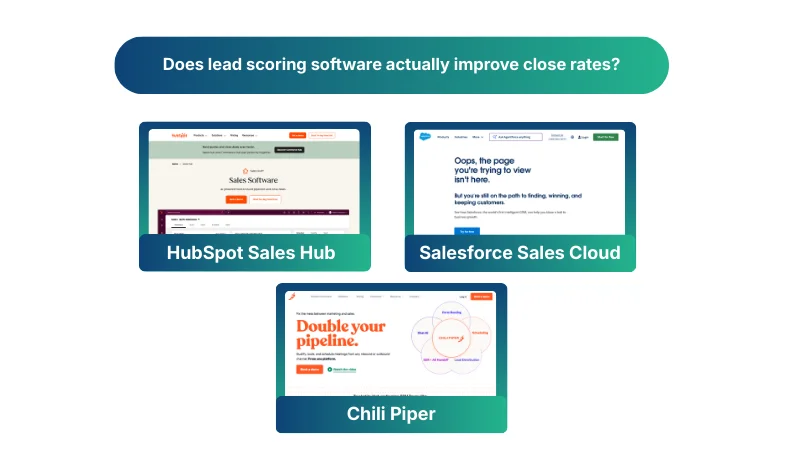
- HubSpot Sales Hub: A CRM and sales platform with built-in lead scoring, pipeline management, and deal tracking. HubSpot’s strength at the Qualify stage is its tight marketing-to-sales handoff: lead activity data from marketing flows directly into the sales view, so reps have full context before the first outreach.
- Salesforce Sales Cloud: The dominant enterprise CRM, with advanced lead scoring through Einstein AI. For SaaS teams at scale, Salesforce’s ecosystem of integrations means it can sit at the center of the entire Revenue-Stage Stack. The tradeoff is implementation complexity and cost.
- Chili Piper: A lead routing and scheduling tool that eliminates the delay between a prospect filling out a form and getting a meeting booked. Chili Piper’s core insight is that speed-to-lead is a conversion lever. SaaS teams that route and book within five minutes of a form fill convert significantly more leads than those that follow up hours later.
Stage 3: Convert — Closing SaaS Deals Faster
The Convert stage is where pipeline turns into revenue. Tools at this stage support the actual sales conversation: demos, proposals, contracts, and signature.
This is also the stage where sales cycle length has the most direct impact on your revenue forecasting. Shorter cycles mean more predictable quarters. The right Convert-stage tools remove friction from the buying process and give reps the information they need to handle objections in real time.
What tools help SaaS sales teams shorten their sales cycle?
The highest-impact tools are the ones that reduce back-and-forth between the rep and the prospect. Interactive proposal tools, in-meeting analytics, and e-signature platforms all remove steps that traditionally require a second or third meeting to resolve. When a prospect can review a proposal, ask questions, and sign in the same workflow, the cycle compresses.
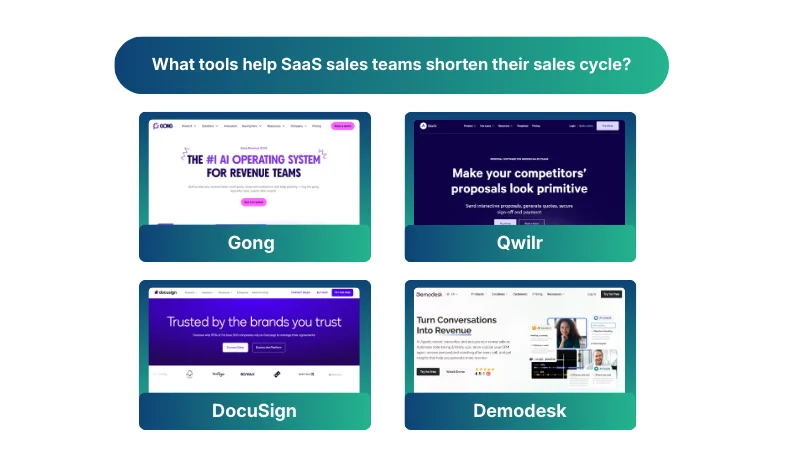
- Gong: A revenue intelligence platform that records, transcribes, and analyzes sales calls. Gong’s differentiation is its deal intelligence: it flags deals at risk based on conversation patterns and benchmarks your reps against what top performers say and do. For SaaS sales teams, it’s most valuable as a coaching tool that scales best-practice behaviors across the team.
- Qwilr: A proposal and sales content platform that replaces static PDFs with interactive web-based proposals. Qwilr tracks prospect engagement with each section of a proposal, so reps know exactly what the buyer read, what they skipped, and where they spent the most time. That data drives sharper follow-up conversations.
- DocuSign: The standard for e-signature and contract management. For SaaS sales, DocuSign reduces the time between verbal agreement and signed contract, which is one of the most common points of deal slippage. Its Salesforce integration means contract status is visible in the CRM without manual updates.
- Demodesk: A sales meeting platform built specifically for SaaS demos. It handles scheduling, screen sharing, and coaching in one interface. What sets it apart is its playbook feature, which guides reps through a structured demo flow and lets managers coach in real time without the prospect seeing.
Stage 4: Expand — Turning Customers Into Pipeline
Most SaaS sales tool guides stop at conversion. That is a significant blind spot.
Expansion revenue — upgrades, cross-sells, and renewals — is often the highest-margin revenue a SaaS company generates. Because customer acquisition cost is already paid, expansion deals carry lower cost and faster cycle times than net-new deals. The tools that support this stage protect your net revenue retention and turn your customer base into a compounding growth asset.
Is expansion revenue really a sales team responsibility?
Increasingly, yes. In product-led growth companies, expansion is often owned by a dedicated expansion sales function or an account management team with quota. Even in traditional SaaS sales motions, reps who manage post-sale relationships are better positioned to identify expansion signals early. The tool infrastructure matters because it determines how much visibility your team has into product usage, health scores, and renewal risk.
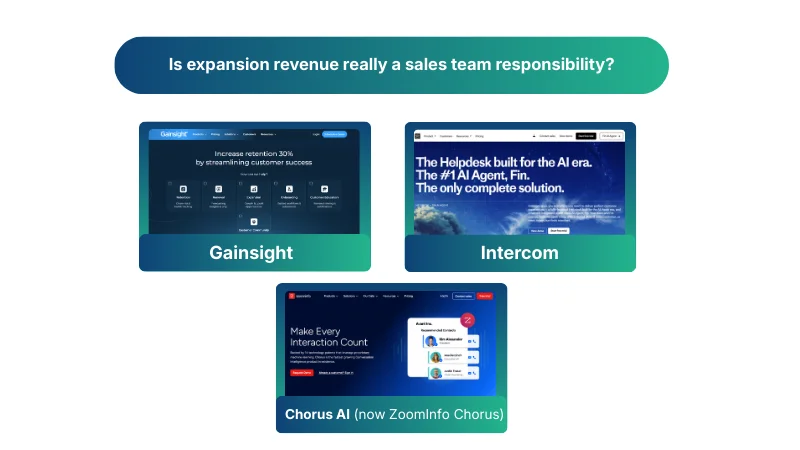
- Gainsight: The leading customer success platform, used to track health scores, flag churn risk, and identify expansion opportunities. For SaaS sales teams with account management responsibility, Gainsight surfaces the right customers to contact and the right moment to reach out.
- Intercom: A customer messaging platform that handles in-app communication, support, and proactive outreach. At the Expand stage, Intercom enables your team to reach customers at the exact moment they encounter a feature gate or usage limit, which is the highest-intent moment for an upgrade conversation.
- Chorus AI (now ZoomInfo Chorus): A conversation intelligence tool that captures and analyzes customer calls, including renewal and upsell conversations. It gives expansion-focused reps the same deal intelligence at the Expand stage that Gong provides at the Convert stage.
Callbox at the Expand Stage
Expansion isn’t just a retention play. Callbox’s model treats post-sale engagement as a direct input to top-of-funnel growth. By nurturing existing customers into advocates and referral sources, Callbox closes the loop between customer success and new pipeline generation. For SaaS companies where word-of-mouth and customer referrals drive a meaningful percentage of new ARR, this stage is not optional. It is foundational.
Discover Calbox’s lead generation program consistently delivered high-quality sales meetings for a SaaS firm in 6 months.
Building Your Revenue-Stage Stack: A Practical Starting Poin
You do not need tools at every stage on day one. In fact, adding too many tools too early is one of the most common mistakes SaaS sales teams make.
A better approach is to identify your biggest pipeline leak first. If your team generates plenty of leads but loses them at qualification, start with a CRM and routing tool. If qualification is strong but deals stall at the proposal stage, invest in Convert-stage tools before adding more at the top. Follow the leak, not the category.
How many tools does a SaaS sales team actually need?
Most high-performing SaaS sales teams operate effectively with five to seven core tools. One CRM, one prospecting or data tool, one outreach platform, one meeting or demo tool, one proposal or contract tool, and one customer success or expansion tool. Everything else is optional. Before adding a new tool, ask which stage it serves and which metric it moves. If you cannot answer both questions clearly, you do not yet need the tool.
The Stack Is Only as Strong as the Pipeline Feeding It
A well-built Revenue-Stage Stack will not perform if the top of the funnel is dry. Tools at the Qualify, Convert, and Expand stages can only operate on the pipeline that the Generate stage creates. This is where most SaaS sales teams hit a ceiling: they optimize the middle and bottom of their stack while underinvesting in consistent, high-quality lead generation.
The teams that break through that ceiling are the ones that treat pipeline generation as a continuous, dedicated function — either through a well-resourced internal SDR team, a managed service partner, or a combination of both. The SaaS sales tools you choose at each stage matter. Getting qualified pipeline into those tools matters more.
Start with the stage where your pipeline is weakest. Build from there. And make sure every tool you add has a stage, a metric, and a clear owner.