How to Boost Your Email Open and Click-Through Rate
Email click-through rates still remain a big challenge for businesses today. Here's how to improve and boost this metric.

Low email marketing click-through rate (CTR) is one of the biggest frustrations marketers face. You spend hours planning campaigns, writing subject lines, and designing templates, only to see your CTR flatline.
Industry averages show that email CTR often hovers between 2% and 3%. That means for every 100 emails you send, fewer than three people are taking the action you want.
Why does this matter? Because CTR is the clearest sign that your email is doing its job. It proves that your content not only reached inboxes but also engaged readers enough to act. Without clicks, your email list is just a list.
In this blog, we’ve grouped the strategies into two parts. The first covers proven, general ways to boost CTR. The second explains how email should be done today with AI-powered strategies that help you send the right message to the right person at the right time.
Why Email CTR is Tougher to Improve Than You Think
Your audience is drowning in emails. Studies show the average professional gets more than 120 emails per day. Most of those are ignored, skimmed, or deleted without a second thought.
Several factors influence your CTR, including:
- A compelling subject line that promises value
- Relevant and personalized content
- A clear and noticeable call-to-action (CTA)
- Mobile-responsive design
- Timing and frequency of your emails.
Other influential elements are the quality of your email list, the overall email design, and the perceived brand reputation.
Here’s a breakdown of these factors:
Content & Offer

- Subject Line: It’s the first impression. If it isn’t clear and valuable, your email won’t get opened, and clicks won’t follow.
- Content Relevance & Personalization: Tailored content gets attention. Generic blasts don’t. Personalize around interests and needs.
- Call to Action (CTA): A vague or buried call-to-action can significantly reduce CTR. Make it obvious, simple, and worth clicking.
- Offer Quality: People are more likely to click on offers that are of high quality. Weak offers, even with strong copy, won’t move the needle.
Discover the 40 B2B Sales Email Templates for better and engaging emails.
Design & User Experience
- Mobile-Responsive Design: Over 60% of emails are opened on mobile devices. Yet, poorly optimized designs drive readers to abandon messages instantly.
- Overall Layout & Readability: Cluttered designs confuse readers. Clean layouts and easy-to-scan content drive clicks.
- Imagery: Strong visuals support your message. Too many images distract from your CTA.
List & Engagement
- Audience Segmentation: Different groups respond to different triggers. Segmenting increases relevance and CTR.
- Email List Quality: Inactive or outdated contacts hurt performance. A healthy, engaged list performs better, which means higher CTA.
- Brand Reputation: Your sender reputation affects deliverability and trust. A trusted brand earns higher engagement.
Strategy & Execution
- Timing: Emails sent at the right time are more likely to be seen and acted on. Research shows emails sent on Tuesdays and Thursdays often perform best. Evening sends, especially between 7 PM and 10 PM, also see higher CTRs.
- Frequency: Too many emails overwhelm, too few make you forgettable. Find the balance that sustains engagement.
- Content Consistency: Ensure the body of your email delivers on the promise made in the subject line. Consistency builds credibility and trust.
When these elements align, your chances of getting meaningful clicks improve dramatically.
What are the most overlooked factors that lower email CTR?
Poor mobile design, inactive email lists, and vague CTAs are often underestimated. Fixing these three issues alone can significantly raise your click-through rate.
Curious why your emails aren’t getting enough clicks? Let’s fix that.
12 Ways to Boost Your Email Marketing Click Through Rate
To improve your email click-through rate, you need to convince people to open and read your email first.
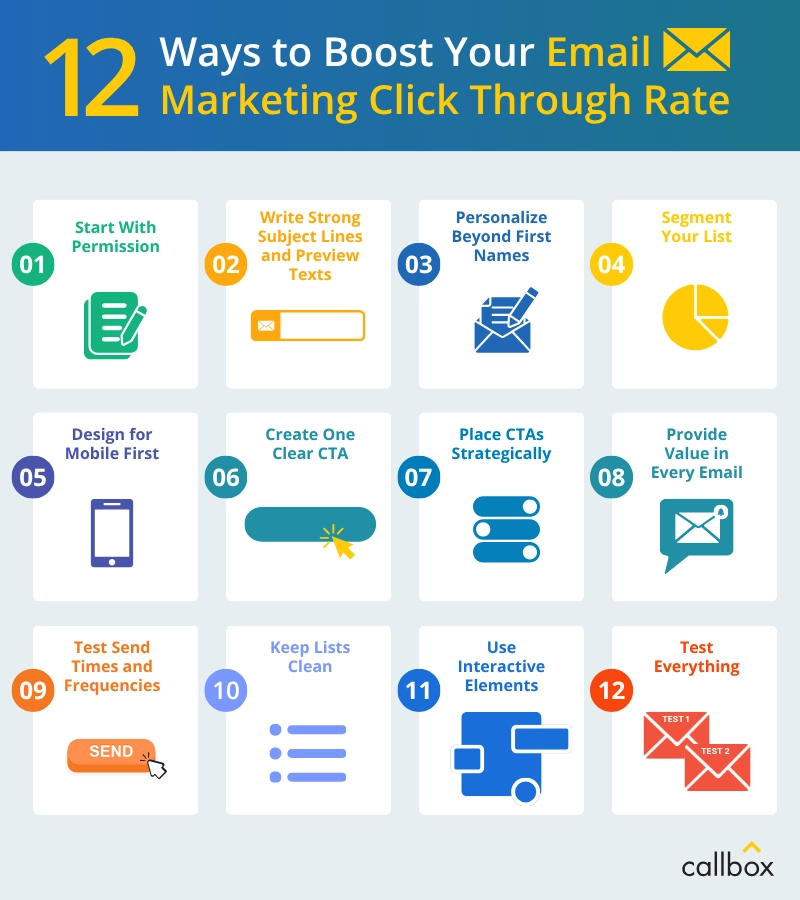
1. Start With Permission
Think about it. If you get a letter from someone you don’t know, what are the chances you’ll open it?
Very low. The same goes for email. If you send messages to people who never agreed to hear from you, they’ll ignore you or unsubscribe.
To avoid this, build your list with opt-in forms or gated content. When subscribers expect your emails, they’re more likely to open, read, and click.
Is asking for permission really that important for boosting CTR?
Yes. Permission-based lists consistently perform better because your audience has already signaled interest. These subscribers open more emails, click more links, and are more likely to convert into leads.
2. Write Strong Subject Lines and Preview Texts
Your subject line earns the open, but the preview text decides if they keep reading. Treat them like a one-two punch. Keep them short, direct, and benefit-focused.
For example, instead of sending “Monthly Newsletter,” try “Your 5-Step Playbook to Increase Sales in Q4.” It promises value and sparks curiosity.
Take a look at how some brands effectively utilize the preview text in conjunction with the subject line. Together, they create a message that’s short, clear, and immediately relevant. That’s what pulls readers in.
How does AI help with subject lines?
AI email marketing tools can test different subject lines in real-time. They can predict which ones will get the most opens. This directly improves your click-through rate (CTR).
Related: Best Email Closing Lines
3. Personalize Beyond First Names
Personalization goes way beyond “Hi John.” People know when you’re sending generic blasts. They tune out.
Instead, use what you know about your subscribers, such as their industry, role, and past behavior. For instance, “See How HR Firms in Canada Are Cutting Onboarding Costs” is more engaging than “Check Out Our New Guide.”
When readers feel like you wrote the email for them, your email CTR improves dramatically.
Why does personalization matter for CTR?
Relevant emails feel valuable. When readers see content tailored to their needs, they’re far more likely to click through.
4. Segment Your List
Not every subscriber wants the same thing. If you treat them all the same, your CTR will suffer.
Divide your list into groups based on demographics, buying stage, or activity level. For example, send product demos to potential customers who visited your pricing page. Also, share thought leadership content with subscribers who are still learning about your brand.
Segmented campaigns feel relevant, and relevance is what gets clicks.
How is AI changing email segmentation?
AI doesn’t just segment by demographics. AI groups people by behavior patterns, engagement history, and intent signals, leading to more intelligent targeting and higher CTR.
Related: Proven Sales Cadence Examples
5. Design for Mobile First
Over half of emails are opened on phones. If your design isn’t mobile-friendly, you’re losing readers instantly.
That means short subject lines, single-column layouts, and big, easy-to-tap buttons. Test your emails on multiple devices before you send. If your email doesn’t load or display correctly, your reader won’t even bother scrolling down to see your CTA.
How much does mobile design affect CTR?
More than 60% of emails are opened on mobile. A design that isn’t optimized for mobile can cut your CTR in half.
6. Create One Clear CTA
A common mistake is cramming too many links into one email. That only confuses readers.
Instead, decide on the single action you want them to take.
- Is it downloading a whitepaper?
- Booking a call?
- Reading an article?
Then make that your focus. Use precise, direct wording, such as “Download the Guide” or “Schedule Your Call Today.”
Does one CTA always perform better than multiple CTAs?
Yes. Emails with a single, well-placed CTA perform up to 42% better than those with several competing actions.
7. Place CTAs Strategically
Don’t make people hunt for your CTA. If it’s buried at the bottom, most won’t reach it.
Add your first CTA above the fold so readers can see it immediately. Repeat it once or twice in the body of the email to catch skimmers. This way, whether someone reads every word or scans quickly, they’ll still find your main action button.
Where should the CTA be placed for maximum clicks?
Above the fold for immediate visibility, and once more midway through to catch scanners.
8. Provide Value in Every Email
Never send emails just to “stay in touch.” If people don’t see value, they’ll stop opening altogether.
Every message should offer something useful, a practical tip, a free resource, or an exclusive invitation. When subscribers see that your emails help them solve problems or gain insights, they’ll pay attention and keep clicking.
What type of content boosts CTR the most?
Content that solves problems or provides immediate value drives the most clicks. This includes how-to guides, industry insights, and limited offers.
9. Test Send Times and Frequencies
Sending an email at the wrong time can bury it under dozens of others. For many audiences, Tuesday and Thursday mornings perform well, but it’s best to test this.
Frequency also matters. Send too often, and people unsubscribe. Send too little, and they forget who you are. A/B test both timing and cadence until you find the sweet spot for your audience.
How does AI improve send times?
AI analyzes subscriber behavior and predicts the optimal time to send emails. This ensures your email arrives when they are most likely to open and click.
10. Keep Lists Clean
Old, inactive subscribers drag down performance. In fact, lists naturally decay by about 30% each year.
That’s why you need to clean your list on a regular basis. Remove unengaged contacts, reconfirm opt-ins, and run re-engagement campaigns to boost engagement. A smaller but active list will always perform better than a massive list of people who never open or click.
Does list size or list quality matter more for CTR?
List quality is more important. A smaller but engaged list consistently outperforms a large, inactive one.
11. Use Interactive Elements
Static text is easy to skim and ignore. Interactive elements, such as polls, surveys, or GIFs, can make people pause.
For example, a short “Which headline do you prefer?” poll not only boosts engagement but also gives you valuable feedback. These small additions can make your emails more engaging, and more engaging emails tend to receive more clicks.
Static text is easy to skim. Polls, surveys, and GIFs can make people pause and interact.
Do interactive elements always increase CTR?
When used strategically, yes. Engagement features encourage clicks, but overloading your email can distract from your primary CTA.
Related: Secrets to Win Your Prospects through Email
12. Test Everything
What works for one audience won’t always work for another. That’s why testing is your best tool.
Experiment with subject lines, CTA wording, button colors, images, and layouts. Track the results and adjust. Continuous testing and optimization are the only ways to sustain higher CTRs long term.
What’s the advantage of AI testing over traditional A/B testing?
AI testing runs multiple experiments simultaneously and adapts in real-time, providing faster and more accurate insights.
How AI-Crafted Emails Drive CTR and Lead Generation
Improving your email click-through rate begins with crafting a message that is more relevant, timely, and engaging. That’s where AI-powered email marketing strategies come in. AI-crafted emails make campaigns smarter, more personalized, and more effective. By combining machine learning with data-driven insights, AI turns every part of your email strategy into an opportunity to increase clicks and generate more qualified leads.
Here’s how AI helps boost CTR in practical ways.
1. AI-driven subject line optimization
Subject lines are one of the biggest factors influencing open rates. With AI, you can predict which words, tone, or formats resonate most with your audience. Smarter subject lines lead to more opens, which then increase the chances of clicks.
Your subject line is the first step to earning a click. AI analyzes past performance and predicts which words, tone, and formats are most effective for different audiences. Instead of guessing, you can test subject lines automatically and send the version that’s most likely to succeed.
How does AI subject line testing work?
AI email marketing tools generate variations, run tests, and predict the winner in real time. This means more opens, and in turn, more clicks.
2. Personalization at scale
Personalization used to mean adding a subscriber’s first name in the subject line or greeting. Today, that’s no longer enough. AI-powered email marketing takes it a step further by analyzing browsing history, purchase behavior, past engagement, and even preferences to create content that feels uniquely tailored for each subscriber.
Can AI really create individualized emails at scale?
Yes. AI-powered platforms dynamically adjust email copy, images, and CTAs based on each person’s profile, making every message feel tailor-made.
This means you can individualize every email at scale. No two subscribers have to see the same version of your campaign. For example, one reader might receive a case study from their industry, another might get a product recommendation based on what they viewed last week, while someone else sees a special discount tailored to their location.
Individualized emails make your message more relevant, which directly impacts CTR. When subscribers see content that speaks to their specific needs and timing, they’re far more likely to click.
Related: Email Marketing Outreach for US B2B Lead Generation
3. Optimized send times
Sending emails at the wrong time often buries your message. AI studies each subscriber’s engagement habits to determine the best time to send. That means your emails arrive when readers are most likely to open and click.
For example, instead of sending to everyone at 9 AM, AI can guide you to schedule emails at the optimal moment for each person.
How does timing affect email CTR?
Emails scheduled with AI-driven timing insights reach subscribers when they’re most attentive. That makes opens and clicks more likely, and helps your message avoid getting lost and unopened.
4. Better lead scoring and nurturing
Every click is more than engagement—it’s a signal of buying intent. AI tracks these signals, scores leads based on their likelihood of conversion, and automatically adjusts nurturing sequences. This ensures your team focuses on high-value prospects who are closer to making a decision.
Smart email marketing teams today blend AI with human strategy. The result is email campaigns that not only generate clicks but also strengthen lead generation pipelines.
Find out why your email nurturing process isn’t converting leads.
How does AI-crafted email improve both CTR and lead generation?
AI helps you optimize subject lines, personalize content, and time delivery for each subscriber. This not only increases clicks but also highlights stronger opportunities for sales follow-up. By combining AI insights with strategic human oversight, businesses see higher CTR and more qualified leads entering the funnel.
5. Continuous Testing and Optimization
Email engagement is never static. What works today may fall flat tomorrow, which makes continuous testing essential. Traditional A/B testing only lets you compare two variations at a time and usually takes days or weeks to see results. AI, on the other hand, can test multiple subject lines, CTAs, and layouts at once while adapting mid-campaign.
Instead of waiting for the next send, AI learns instantly from each interaction and applies those insights right away. This means your campaigns are continuously refined in real time, improving performance with every email.
Why is AI testing better than manual A/B testing?
Traditional A/B testing takes time and only compares two variations. AI runs multiple tests at once, adapts mid-campaign, and delivers results faster.
6. Dynamic Content Recommendations
Sending one generic email to your entire list often leads to low engagement. AI changes this by analyzing browsing behavior, past purchases, and recent clicks to recommend the most relevant content for each subscriber.
This allows every person on your list to receive an individualized experience—one subscriber might get product demos while another sees industry insights. The result is more relevant emails that encourage readers to click.
How does dynamic content recommendations improve CTR?
When subscribers see content that reflects their immediate interests, they’re far more likely to engage with your links.
Common Mistakes That Kill CTR
Even experienced marketers fall into traps that hurt CTR. Avoid these mistakes:
- Overloading your email with multiple CTAs
- Ignoring mobile optimization
- Using vague or misleading subject lines
- Sending too frequently without adding value
- Neglecting inactive subscribers
Fixing these issues alone can significantly boost email CTR.
What’s the biggest mistake that hurts CTR?
Sending irrelevant emails. When subscribers don’t find value, they stop engaging altogether.
Key Metrics to Track
Clicks are necessary, but you also need to monitor other metrics:
- Click-to-open rate (CTOR): Indicates the effectiveness of your content once it is opened.
- Bounce rate: High bounces can signal poor list quality.
- Unsubscribes: Rising numbers suggest your content isn’t resonating.
By monitoring these, you’ll get a clearer picture of what’s working and what needs adjustment.
Which metric is most important for long-term email success?
CTR is critical, but CTOR gives more profound insight into whether your content is truly engaging your audience.
Final Thoughts
Your email marketing click-through rate is the most critical metric to watch. It reflects how well your content engages readers and drives action. By focusing on relevance, personalization, timing, and clear CTAs, you’ll see stronger results.
AI email marketing can help you improve these strategies. However, the basic idea stays the same: send the right message to the right person at the right time.
The inbox is crowded. But with the right approach, your emails won’t get lost. They’ll get opened, read, and most importantly, clicked.