Why Email Marketing in APAC Continues to Drive B2B Results
Discover how to build a winning email program that reaches decision-makers and drives conversions in Singapore.


If you work with an APAC B2B sales team, especially in Singapore, you know how hard it is to connect with decision-makers at the right time. That’s why more marketers are turning to proven lead generation solutions that prioritise consistency and measurable outcomes.
For many businesses, working with an email marketing lead generation agency has become essential to stay competitive in markets where relationships and timing drive pipeline results.
This article will explain why email marketing is a top choice for reaching B2B prospects in Singapore. We’ll define modern email marketing, highlight its strengths, and share seven key statistics that show its ongoing importance in digital marketing.
What is Email Marketing, and Why Does It Work So Well?

Email marketing is a direct, opt-in communication method that businesses use to engage prospects and customers with tailored content. Unlike broad advertising methods, it focuses on delivering personalized email experiences that guide contacts through the sales funnel.
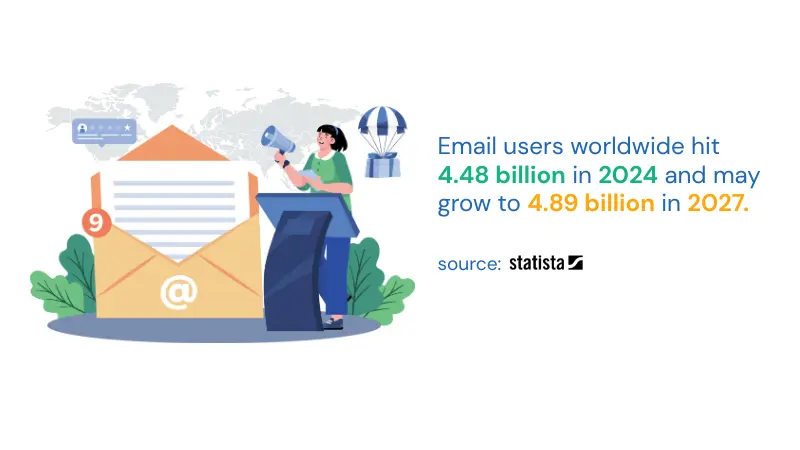
In 2024, there were 4.48 billion global email users, and analysts predict that number will increase to 4.89 billion by 2027. Furthermore, 87% of marketing leaders agree that email marketing is crucial to the success of their company, highlighting its importance as a key strategy in business communication and growth.
The popularity of electronic direct mail (EDM) stems from its alignment with how professionals prefer to consume information: privately, at their own pace, and through platforms they trust.
An effective email marketing program does more than announce offers. It builds authority, creates conversations, and opens up opportunities for long-term client relationships. Whether for cold email lead generation or a lead-nurturing sequence, email consistently delivers better closed-won results in SaaS, FinTech, manufacturing, and enterprise IT.
The Advantages of Email Marketing for B2B
The success of EDM marketing lies in its simplicity and impact. Here’s why it remains an essential part of your strategy:
- Direct access to decision-makers
Email reaches the most relevant people, such as finance heads, IT managers, and regional marketing leaders, without competing with other marketing channels.
- Scalable personalization
Using platforms like Mailchimp, HubSpot, or ActiveCampaign, marketers can send customized EDM emails based on role, industry, and buyer stage. This leads to higher engagement and more appointments.
You control frequency, targeting, and creative. And with detailed reporting, every program provides insights that help improve the next one.
Discover how Callbox generated 98 appointments and improved email KPIs for a Singapore government agency.
- Alignment with APAC buying behavior
B2B buyers in Singapore often require multiple touchpoints before they make a decision. Email allows you to deliver consistent, non-intrusive value over time.
5 Stats That Prove Email Marketing Still Leads
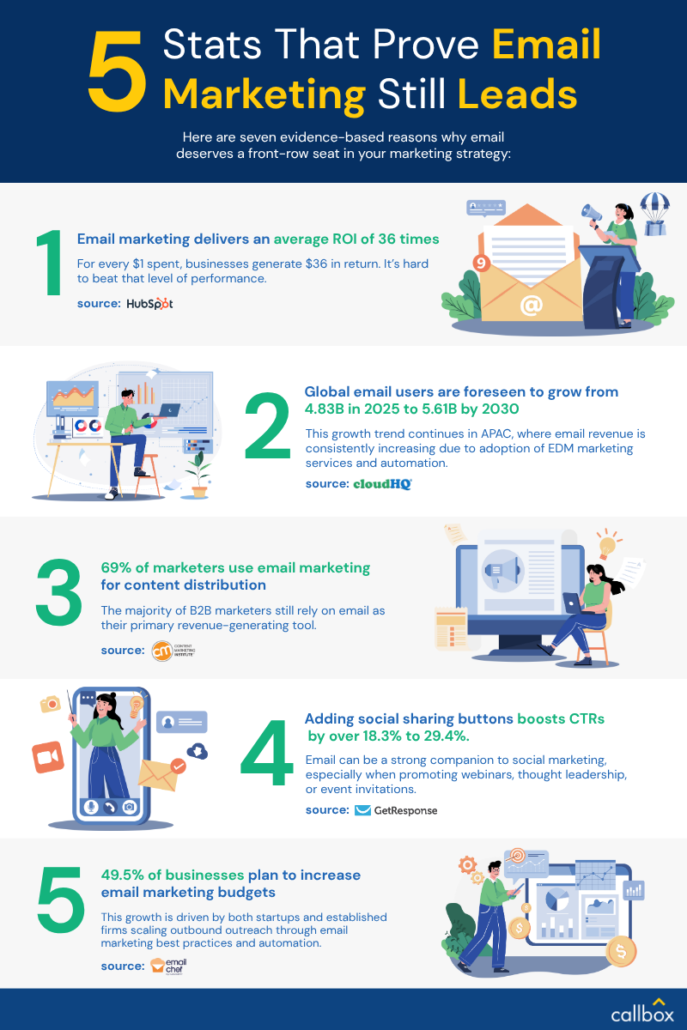
Here are seven evidence-based reasons why email deserves a front-row seat in your marketing strategy:
1. Email marketing delivers an average ROI of 36 times
For every $1 spent, businesses generate $36 in return. It’s hard to beat that level of performance.
2. Global email users are foreseen to grow from 4.83B in 2025 to 5.61B by 2030.
This growth trend continues in APAC, where email revenue is consistently increasing due to adoption of EDM marketing services and automation.
3. 69% of marketers use email marketing for content distribution
The majority of B2B marketers still rely on email as their primary revenue-generating tool.
4. Adding social sharing buttons boosts CTRs by over 18.3% to 29.4%.
Email can be a strong companion to social marketing, especially when promoting webinars, thought leadership, or event invitations.
5. 49.5% of businesses plan to increase email marketing budgets
This growth is driven by both startups and established firms scaling outbound outreach through email marketing best practices and automation.
Not seeing results to your email marketing outreach?
What Makes an Email Marketing Program Work
Creating an effective email marketing program involves more than just list-building and blasting out content. It’s a strategic process that combines audience insights, precision timing, and value-driven communication.
Success comes from delivering relevant messages that address your audience’s pain points, expectations, and readiness to act. Each component of your program must be thoughtfully designed, from the recipient to the timing, method, and content of your message.
Segmentation
Segmentation is key to personalised communication. Instead of treating your audience the same, break them into specific groups based on job role, company size, industry, buying stage, or recent behaviour.
For example, an email to a procurement manager in a logistics firm will differ from one to a marketing director in SaaS. The more detailed your segmentation, the more relevant your message becomes, and relevance drives higher open rates and engagement.
In markets like Singapore, segmentation helps ensure your message reaches the right people. Use tools to filter and tag your contact database. Whether for cold email lead generation or post-event follow-ups, segmentation ensures your content addresses your audience’s specific needs and decision-making process.
Explore how to master email follow-ups for Singapore events
Timing
Timing in email isn’t about sending something “soon” but about sending it at the right moment for maximum impact. Research shows that midweek mornings (particularly Tuesdays and Thursdays between 9 and 11 am) often yield the highest open rates for B2B programs.
But this isn’t universal. You need to test and monitor when your audience is most receptive to your message. Utilise tools that track opens and clicks to determine what works best for your target segment.
In APAC, timing also needs to consider regional work cultures and business hours. For example, decision-makers in Singapore and Australia may have different holiday calendars, while business operations in Malaysia or India could affect weekday engagement patterns.
An email marketing program that performs well in one region might fall flat in another if you don’t time it correctly. Smart marketers experiment with drip schedules, time-zone-optimised sending, and re-engagement automation to keep the conversation alive.
Messaging
Your messaging is what turns an open into a conversion or not. B2B prospects, especially in senior roles, don’t have time for fluff. A good electronic direct mail message gets to the point, focuses on value, and presents a clear next step.
Subject lines must be short and specific. Your preview text should clearly reinforce what readers will gain by continuing to read. And once inside, the email should immediately communicate relevance, why this matters, why now, and what they can do next.
Avoid jargon and salesy buzzwords. Instead, lead with insights or pain-point solutions tailored to the recipient’s role. For example, if you’re sending to IT directors, focus on operational efficiency or compliance improvements.
If it’s for a head of procurement, highlight cost savings or supply chain optimisation. Every EDM marketing message should be shaped by what matters to the reader, not what you want to say.
Design
Design plays a bigger role in performance than many marketers realise. With more B2B decision-makers reading emails on mobile devices, responsive formatting is non-negotiable. Your EDM mail should load quickly, use a clear hierarchy, and be skimmable on any screen. Stick to single-column layouts, short paragraphs, and plenty of white space.
Visual clarity also supports brand consistency. Use clean templates that reflect your visual identity without overwhelming the message. Include prominent CTAs that are easy to tap on mobile.
For audiences in Singapore and the broader APAC region, simplicity is often more effective than flashy design. Let your message and its value stand out, not aside from the graphics.
Planning to launch your email marketing? Use this email marketing analytics cheat sheet for quick tracking and optimization!
Integrating Email with Your Broader Lead Generation Efforts
For companies looking to scale their outreach in the APAC region, especially those seeking to connect with decision-makers in Singapore, email marketing shouldn’t exist in a silo. It should be part of an integrated strategy that blends human touchpoints, digital programs, and buyer behaviour insights.
Start by using lead-nurturing emails to stay top-of-mind after initial engagement, whether from a webinar, a form submission, or a cold call. Create sequences that build value over time through industry insights, success stories, or time-sensitive offers.
Next, incorporate cold email lead generation to reach new segments using targeted messaging that feels consultative rather than promotional.
Complement these efforts with relevant content distributed through electronic direct mail, such as whitepapers, event invitations, or service updates.
Sync your email programs with retargeting ads and outbound calling efforts for higher brand recall and conversion rates. A well-aligned EDM marketing approach can bridge gaps across your marketing funnel and create stronger momentum for your sales pipeline.
Email vs. Other Channels: A Quick Comparison
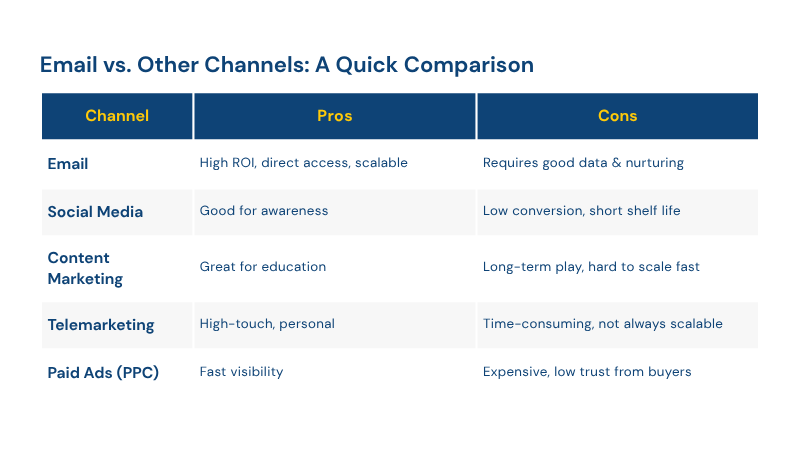
| Channel | Pros | Cons |
| High ROI, direct access, scalable | Requires good data & nurturing | |
| Social Media | Good for awareness | Low conversion, short shelf life |
| Content Marketing | Great for education | Long-term play, hard to scale fast |
| Telemarketing | High-touch, personal | Time-consuming, not always scalable |
| Paid Ads (PPC) | Fast visibility | Expensive, low trust from the buyer |
Final Takeaway: Email as a Growth Channel
Despite the growth of social media and automation tools, email is still one of the most effective channels in B2B marketing. In Singapore and the APAC region, where business communication is formal and professional, email provides the consistent, personal engagement that high-value leads respond to.
Modern email marketing is not just about sending newsletters or promotions; it’s also about building relationships. It helps you build trust, deliver customised content, and guide buying decisions over time.
Top brands don’t treat email as just another task. They utilise it to establish long-term relationships, position themselves as industry experts, and convert interest into action.
If your email outreach isn’t performing well, it’s time to rethink your approach. From segmentation and content strategy to automation and design, every detail matters. With the proper structure and partner, email marketing can remain your most reliable and scalable lead generation channel.


