What are the Best Sources for High-Quality Verified Phone Leads
Learn where to find high-quality verified phone leads, how data is validated, and what B2B teams should consider when scaling outbound sales.

Cold calling is dead.
You’ve probably heard this more times than you can count.
Yet for many B2B sales teams, outbound calling still plays a meaningful role in starting real conversations with decision-makers. What’s changed isn’t the channel itself, but the margin for error. When the data is right, calls connect. When it isn’t, even the best outreach strategy falls flat.
Across outbound organisations, one pattern keeps surfacing: performance doesn’t decline because teams stop calling, it declines because reps are dialling switchboards, outdated landlines, or recycled lists. As data quality drops, connect rates follow. That’s why high-quality verified phone leads, including direct dials and mobile business phone numbers, remain a critical input for both SDR productivity and pipeline efficiency.
In this article, we’ll break down the best sourcing options, how phone data is validated, and what to consider when scaling outbound across regions.
Get reps trained on phone validation, direct dials, and mobile outreach
What Are Verified Phone Leads (and What “Verified” Really Means)
At a surface level, verified phone leads sound simple: phone numbers that work. But for SDRs and sales leaders alike, “verified” needs to mean something more concrete.

What qualifies as a verified phone lead in B2B sales?
In practical terms, a verified phone lead is a business contact whose phone number has been recently checked for accuracy, still belongs to the intended contact, and is reachable without going through a switchboard.
For SDRs, that means fewer dead dials and more live conversations. For executives, it means outbound activity that produces a measurable pipeline, not just call volume.
High-quality B2B phone leads typically meet a few non-negotiables:
- The number reaches a real person, not a switchboard
- The contact still holds the role being targeted
- The number has been recently validated
- The data can be used compliantly for outbound outreach
When any of these break down, the cost shows up fast. Which means missed connections for SDRs, wasted spend, and low efficiency at the leadership level.
High-quality B2B phone leads go beyond basic validation. They prioritise direct dials over switchboards, include mobile numbers for decision-makers, and are refreshed regularly to account for data decay.
Why Most B2B Phone Data Fails in Outbound Sales
Outbound calling often gets blamed when results slip, but the real issue is usually the data behind the calls.

Why does B2B phone data go bad so quickly?
Because people change roles, companies restructure, and phone numbers are reassigned far faster than most databases are refreshed.
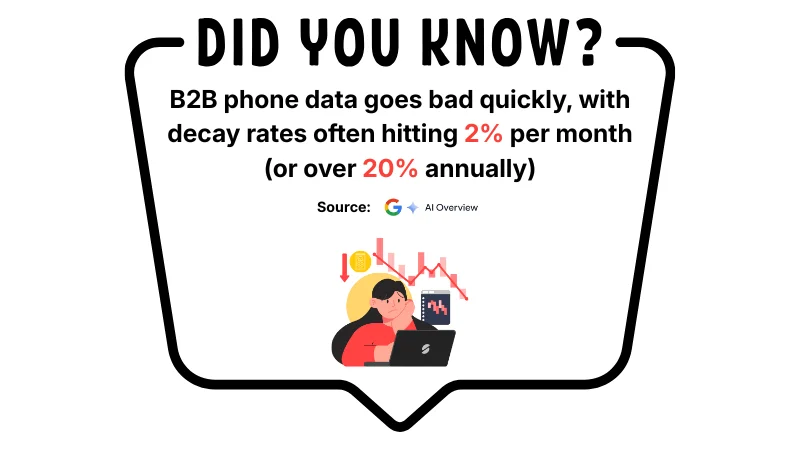
Across outbound teams, the same issues surface repeatedly:
- Contacts move jobs without notice
- Mobile numbers get recycled
- Widely shared datasets decay faster
- “Verified” often means verified once, months ago
For SDRs, this shows up as low connect rates and frustrating call blocks. For leaders, it shows up as declining outbound ROI and efficiency concerns. Without continuous phone number validation, even large volumes of sales phone leads stop delivering value.
No recruiting delays, onboarding risk, or short-term campaigns.
What Are the Best Sources for High-Quality Verified Phone Leads?
No single source works for every outbound strategy. Most successful teams combine multiple sources depending on scale, precision, risk tolerance, and region.
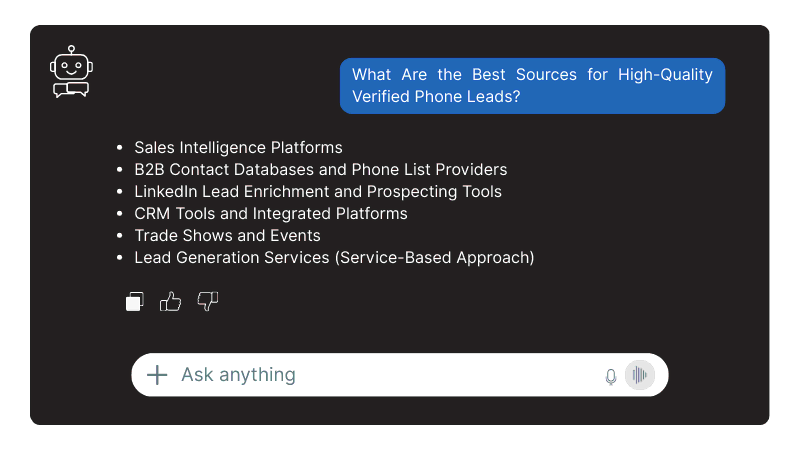
So, where do most B2B teams actually get verified phone leads?
Typically, they rely on a mix of sales intelligence platforms, contact databases, LinkedIn enrichment tools, CRM-integrated data sources, event-driven leads, and service-based lead generation providers. Each serves a distinct role in the outbound motion.
Sales Intelligence Platforms
Sales intelligence platforms are often the backbone of outbound programs. They provide access to large B2B contact databases, enriched with phone numbers, firmographics, and buying signals.
Platforms such as ZoomInfo, Apollo.io, UpLead, Lusha, and RocketReach are commonly used by SDR teams to build call lists and prioritise outreach at scale.
Are sales intelligence platforms enough on their own?
They’re excellent for scale, but rarely sufficient for accuracy without additional validation.
For SDRs, these platforms speed up list building and prioritisation. For executives, they provide visibility and volume across the funnel.
That said, most teams eventually notice trade-offs:
- Data accuracy varies by region and role
- Direct dials and mobile numbers aren’t always available
- Widely used datasets degrade faster
B2B Contact Databases and Phone List Providers
Dedicated business contact databases and phone list providers focus on delivering B2B phone lists and telemarketing lists at scale.
When do phone list providers make sense?
They’re most useful when teams need:
- Bulk phone leads quickly
- Industry-specific or role-based lists
- Short-term campaign support
For SDRs, lists fill call queues fast. For sales leaders, the risk lies in assuming list size equals lead quality. Without segmentation, refresh cycles, and compliance checks, list-based outreach often increases activity without improving outcomes.
LinkedIn Lead Enrichment and Prospecting Tools
LinkedIn remains one of the most reliable sources for identifying decision-makers, but it doesn’t provide phone numbers by default. The challenge here is turning profiles into callable contacts.
How do teams turn LinkedIn leads into callable contacts?
By using LinkedIn lead enrichment and phone or contact discovery tools that append direct dials or mobile numbers to verified profiles.
For SDRs, this enables highly targeted outbound by using them to turn Sales Navigator leads into dial-ready contacts.
For executives, it supports account-based strategies where precision matters more than scale. The trade-off is volume, but the payoff is relevance.
The upside is clear:
- Higher-quality direct dial leads for SDRs
- Better alignment with ICPs
- Stronger account penetration
Explore how to do LinkedIn lead generation the right way
CRM Tools and Integrated Platforms
For many teams, some of the most reliable phone leads are already inside their CRM, that is, if the data is maintained properly.
Can CRM tools be a source of verified phone leads?
Yes, especially when CRM platforms are paired with ongoing data enrichment and validation.
Modern CRM tools, when integrated with enrichment workflows, allow teams to find someone’s phone number using verified data from existing accounts, inbound leads, past opportunities, and reactivated contacts.
For SDRs, this reduces cold-start friction. For executives, it improves ROI by extracting more value from data the company already owns.
The key is ensuring CRM data is continuously enriched and validated, not treated as static storage.
Trade Shows and Events
Trade shows, conferences, and virtual events remain an overlooked but powerful source of phone leads when handled correctly.
Are event-generated phone leads actually high quality?
They can be, provided the data is verified and followed up on quickly.
Event leads often include direct contact details shared voluntarily, making them valuable for SDRs conducting warm outreach. For leaders, the challenge is operational: without post-event validation and enrichment, event data decays quickly and loses momentum.
When event leads are validated, enriched, and integrated into outbound workflows, they can bridge the gap between inbound interest and outbound execution.
Planning to launch your B2B event? Learn how to attract attendees and convert them into deals
Lead Generation Services (Service-Based Approach)
For some teams, the margin for error in outbound sales is simply too small to rely on static data sources alone, especially when deal sizes are large, regions are complex, or compliance requirements are strict.
When do outsourced lead generation services make more sense than tools or lists?
When accuracy, consistency, and accountability matter more than raw volume.
Unlike databases or enrichment tools, a service-based approach treats phone lead generation as an ongoing process rather than a one-time data pull. These providers actively research target accounts, verify phone numbers, confirm decision-maker roles, and continuously refresh data to account for changes over time.
For SDRs, this means fewer wasted dials and more conversations with the right people. For sales leaders, it means a more predictable outbound engine, one that’s easier to scale, manage, and defend from a performance and compliance standpoint.
This is where companies like Callbox fit into the picture. Instead of simply supplying lists, Callbox operates as an extension of sales and marketing teams, combining human-verified phone leads with a multi-channel, compliance-aware outbound framework. The result is outbound activity that’s built around real conversations and pipeline contribution, not just call volume.
Callbox embeds SDRs who are region-trained and compliance-aware, whether you’re expanding from the US, Singapore, or Australia
What Are the Best Methods to Secure Verified Phone Data?
High-quality phone data isn’t secured through a single tool or one-time check.
How is phone data actually verified in practice?
Through layered processes that combine automation, enrichment, and human validation.
Reliable methods typically include:
- Real-time phone number validation to confirm reachability
- Human-in-the-loop verification for role accuracy
- Phone number enrichment to append missing direct dials
- Filtering direct dials versus switchboards
- Mobile number confirmation for senior stakeholders
- Ongoing refresh cycles to manage data decay
For SDRs, this leads to better daily calling outcomes. For leaders, it creates outbound systems that hold up over time.
What Compliance and Privacy Requirements Do You Need to Consider?
Outbound phone outreach doesn’t just carry performance risk—it carries legal and reputational risk if compliance is overlooked.
Any source of verified phone leads should account for:
- GDPR-compliant data handling for EU and UK contacts
- Respecting national and Do Not Call (DNC) compliance across applicable regions
- Legitimate interest frameworks for B2B outreach
- Transparency around how the data was sourced
- Regional variations in privacy regulations
From an SDR perspective, compliance protects day-to-day execution. From an exec perspective, it protects the business from fines, blocked campaigns, and brand damage.
Best Sources to Find Verified Phone Leads by Region
Phone lead quality varies widely by region because regulations, data availability, and calling behaviours differ across markets. As a result, the way teams source and verify phone leads in one region often doesn’t translate cleanly to another.
APAC (Asia-Pacific)
In APAC, phone data is highly fragmented and mobile-first, which makes local validation critical.
What does verified phone lead sourcing look like in APAC?
Most teams rely on a combination of region-specific data providers and service-based research to ensure numbers are current and reachable.
For example, an SDR team targeting IT decision-makers in Singapore or Australia may start with a global sales intelligence platform to identify accounts, then rely on enrichment and manual verification to confirm mobile business phone numbers. In markets like Southeast Asia, where job mobility is high and directories are inconsistent, outsourced lead generation services are often used to validate numbers locally before dialling.
For executives, this approach reduces wasted outbound activity and avoids compliance risks tied to cross-border data handling.
See how an NYC-based company grows its customer base in Southeast Asia with managed SDR augmentation
NAM (North America)
North America offers the most mature ecosystem for verified business phone numbers, direct dials, and enrichment tools.
How do most teams source phone leads in North America?
Typically, through sales intelligence platforms and CRM-integrated enrichment, supplemented by validation workflows.
An SDR team selling SaaS in the US or Canada might pull direct dials from a sales intelligence platform, enrich records inside their CRM, and prioritise contacts based on role and intent signals. Because data availability is strong, teams can scale quickly, but accuracy still depends on refresh frequency and role validation.
From a leadership perspective, NAM allows for efficient scaling, but performance still hinges on how well data decay is managed.
LATAM (Latin America)
In LATAM, frequent number reassignment and mobile dependency make ongoing validation essential.
What’s the most reliable way to source phone leads in LATAM?
A hybrid approach that combines tools for scale with human verification for accuracy.
For instance, teams targeting Brazil, Mexico, or Colombia often start with a global database to identify companies, then rely on enrichment and service-based validation to confirm mobile numbers. Because phone numbers change hands more frequently, static lists lose accuracy quickly.
For SDRs, this reduces dead dials. For executives, it helps maintain outbound efficiency in markets where raw data quality can be inconsistent.
United Kingdom
(For UK B2B Companies Expanding Outside the UK)
UK-based companies expanding internationally face a different challenge: maintaining compliance while adapting to new markets.
How do UK companies source phone leads when expanding globally?
Most combine GDPR-compliant data providers with localised verification and service-based lead generation.
For example, a UK software company expanding into North America or APAC may source initial contacts from compliant global platforms, then work with outsourced lead generation services to validate phone numbers regionally. This ensures that outbound teams aren’t applying UK-centric assumptions to markets with different calling norms and data rules.
For leadership teams, this approach balances growth with governance, protecting brand reputation while enabling scale.
How to Evaluate the Quality of Verified Phone Leads
Before committing to any source, teams need to pressure-test quality.
How can you tell if phone leads are actually high quality?
By checking how recent, reachable, compliant, and role-accurate the data is.
Key questions include:
- Are these direct dials or switchboards?
- When was the number last validated?
- Is the mobile number role-confirmed?
- How often is the data refreshed?
- Is the data compliant across regions?
High-quality telemarketing phone leads reduce friction at every level of the sales organisation.
Tools vs Lists vs Services: Which Source Is Right for You?
Each source plays a different role.
Is one source better than the others?
Not universally. The right choice depends on scale, deal size, region, and risk tolerance.
- Tools support scale and internal prospecting
- Lists enable fast deployment and short-term volume
- Services prioritise accuracy, compliance, and complexity
Most mature outbound programs blend all three, aligning each source to the job it does best.
See how much ramp time you can eliminate.
Final Thoughts
Cold calling isn’t dead, but it’s far less forgiving than it used to be.
The teams that still win with outbound are the ones that treat verified phone leads as a strategic input, not an afterthought. When phone data is accurate, compliant, and aligned with how sales teams actually work, outbound stops feeling like a grind and starts producing real conversations again.