








Sales and marketing teams share the same goal: revenue.
However, many companies still struggle because they lack a clear sales and marketing alignment strategy. As a result, leads stall, follow-ups weaken, and forecasting becomes unreliable.
Silos form when teams track different metrics. Marketing measures engagement. Sales measures closed deals. Leadership measures revenue. Therefore, disconnect spreads across the funnel.
A structured sales and marketing alignment strategy eliminates this friction. It connects targeting, qualification, messaging, reporting, and nurturing into one system.
What this guide covers:
This guide explains what sales and marketing alignment means and why it drives measurable growth. You will also learn how to build a practical sales alignment strategy that improves conversion rates and pipeline predictability.
Stop losing deals to misalignment. Sync sales and marketing to grow pipeline.
What Is Sales and Marketing Alignment?
Sales and marketing alignment means both teams coordinate goals, messaging, and performance tracking.
It goes beyond meetings. Instead, it requires shared definitions and shared accountability. Marketing does not stop at lead generation. Sales does not operate without campaign context.
Research consistently shows that alignment improves revenue outcomes. HubSpot reports that aligned sales and marketing teams generate significantly higher growth rates compared to misaligned organizations.
What defines a strong sales alignment strategy?
A strong sales alignment strategy includes clear MQL and SQL definitions, shared dashboards, and defined follow-up timelines.
Why does alignment matter now?
Buying groups continue to grow. According to Gartner, B2B buying decisions often involve six to ten stakeholders. Therefore, teams must coordinate messaging across every touchpoint.
Related: Reasons Why Your Sales Team is Underperforming
Signs Your Sales and Marketing Strategies Are Not Aligned
Misalignment rarely appears as one major failure. Instead, it shows up in small revenue leaks that compound over time.

If your sales and marketing alignment strategy lacks structure, you will notice these warning signs.
Sales rejects marketing leads
Sales questions lead quality or delays follow-up. Meanwhile, marketing insists the leads meet targeting criteria. Trust declines quickly.
Pipeline looks strong, but revenue stalls
Lead volume increases. However, closed deals remain flat. This gap signals weak alignment marketing execution.
McKinsey highlights that B2B decision processes have become more complex and nonlinear. Without coordination, revenue stalls despite strong top-of-funnel activity.
Teams report different numbers
Marketing highlights engagement metrics. Sales highlights revenue metrics. Leadership cannot connect both dashboards. Consequently, forecasting weakens.
Messaging shifts mid-funnel
Prospects hear one promise in campaigns and another in sales conversations. Confusion slows decisions.
Follow-up lacks discipline
Leads sit untouched in the CRM. Response times increase. Engagement drops.
How do you quickly diagnose alignment gaps?
Review lead-to-opportunity conversion, response time, and shared KPI dashboards. If teams track different success metrics, misalignment exists.
Hitting bigger revenue targets requires more coverage, let’s extend your team the smart way.
5 Ways to Strengthen Your Sales and Marketing Alignment Strategy
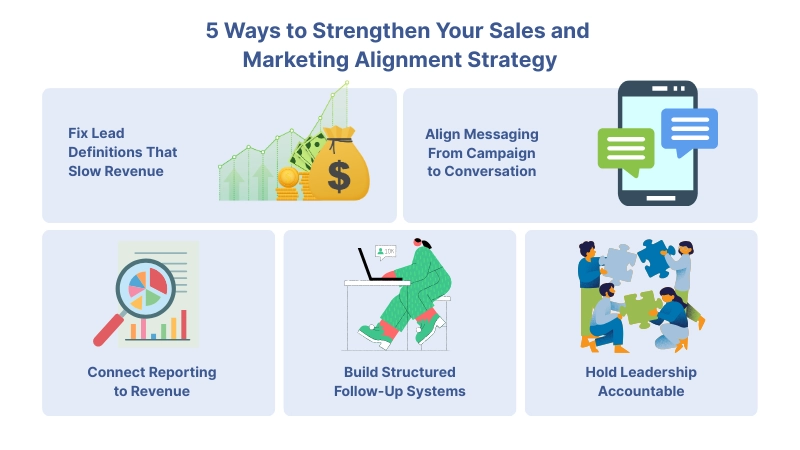
1. Fix Lead Definitions That Slow Revenue
Many teams disagree on what qualifies as a real opportunity.
Marketing may prioritize engagement. Sales may prioritize urgency and authority. Because of this mismatch, leads go untouched. Aligning sales and marketing strategies starts with real data. Review your last closed deals. Identify patterns in role, company size, timeline, and buying signals. Then document those traits clearly.
How do you standardize qualifications?
Audit recent wins. Extract common characteristics. Create a written checklist. Share it across both teams. Clear standards reduce friction. As a result, trust improves and conversion rates increase.
See how Callbox’s appointment setting program accelerates the sales growth of an AI Technology firm.
2. Align Messaging From Campaign to Conversation
Prospects notice inconsistencies quickly.
If marketing promotes innovation but sales focuses on cost reduction, confusion follows. Consequently, credibility drops.
Alignment marketing ensures campaign messaging reflects real sales conversations. Sales objections should guide content creation. Meanwhile, marketing insights should support outreach scripts.
How do you unify messaging?
Hold monthly feedback sessions. Review call notes. Translate objections into campaign copy and nurture emails. When messaging aligns, engagement improves across the funnel.
Related: Things to Say Prospect Considering Other Options
3. Connect Reporting to Revenue
Disconnected dashboards create disconnected decisions.
Marketing often reports clicks and form fills. Sales reports pipeline and revenue. Leadership cannot see the full picture. Therefore, budget decisions lack clarity.
A strong sales and marketing alignment strategy integrates CRM and automation systems. Both teams track cost per opportunity, lead-to-close rate, and sales cycle length.
What metrics should both teams share?
Cost per SQL, conversion rate, and campaign-driven revenue.

Shared reporting improves accountability. Moreover, it strengthens forecasting accuracy.
4. Build Structured Follow-Up Systems
Most B2B deals require multiple touchpoints.
However, many teams rely on inconsistent follow-ups. As a result, prospects disengage.
A strong sales alignment strategy includes lifecycle-based nurturing. Marketing supports education through content and retargeting. Sales maintains direct outreach through calls and LinkedIn.
What channels improve nurturing results?
Email, voice, LinkedIn, webinars, and event follow-ups drive consistent visibility. Structured engagement keeps accounts warm until they are ready to buy.
Check out these sales lead nurturing strategies for better conversion.
5. Hold Leadership Accountable
Alignment fails without executive ownership.
If marketing focuses only on volume and sales focuses only on quota, silos return. Therefore, leadership must tie incentives to shared revenue goals.
Executives should run joint pipeline reviews. They should require shared KPIs. Most importantly, they should reinforce cross-team accountability.
How often should teams review alignment?
Run weekly tactical reviews. Conduct monthly performance reviews. Adjust strategy quarterly.
Leadership discipline transforms sales and marketing alignment into operational reality.
Regional Considerations in Aligning Sales and Marketing Strategies
Sales and marketing alignment is not one-size-fits-all. The structure may be universal, but execution depends heavily on regional buying behavior, regulatory environment, and sales maturity.

If you apply the same alignment framework everywhere without adapting it, friction returns. Here’s how alignment challenges typically vary by market.
- North America – Complex buying committees require tight coordination and strong CRM integration.
- APAC – Digital adoption grows rapidly. However, infrastructure maturity varies. Teams must adjust messaging accordingly.
How do you maintain consistency across regions?
Use one framework. Then adapt ICP criteria and messaging based on local buying behavior.
Ready to expand your market reach and win more qualified buyers?
How to Implement a Scalable Sales Alignment Strategy
Alignment does not happen because teams agree it is important. It happens because leaders operationalize it.To truly eliminate friction between sales and marketing, alignment must move from concept to system.
The following steps provide a practical roadmap. These are not theoretical recommendations, but operational shifts that connect strategy to execution.
- Define shared revenue goals: Both teams must own one measurable target.
- Document qualification standards: Align MQL and SQL definitions clearly.
- Integrate CRM and automation: Ensure complete visibility across touchpoints.
- Establish structured feedback loops: Use sales insights to improve campaigns.
- Build lifecycle-based nurturing: Engage prospects from awareness to expansion.
- Use multi-channel outreach: Combine email, phone, LinkedIn, and events.
When internal resources stretch thin, external expertise accelerates execution.
Callbox accelerates revenue by engaging prospects after brand awareness and converting them into qualified meetings, closed deals, and loyal customers. Once customers are acquired, we don’t stop.
Callbox then nurtures them into repeat business, advocacy, referrals, and expansion opportunities, feeding revenue back into the top of the funnel. This creates a self-reinforcing growth engine that continuously scales pipeline, accelerates sales, and maximizes customer lifetime value.
What improves alignment fastest?
Clear qualification standards, shared dashboards, and disciplined follow-up.
Why does alignment increase revenue predictability?
Because every campaign ties directly to measurable pipeline impact.
Revenue Slows Where Alignment Breaks
Sales and marketing silos weaken performance. They reduce conversion rates and distort forecasting.
A structured sales and marketing alignment strategy removes friction. It connects teams under shared goals, shared reporting, and shared accountability. Consequently, pipeline strengthens and revenue stabilizes.
When teams move together, growth accelerates.