







Southeast Asia has become one of the most attractive markets for global expansion. With a combined population of more than 680 million, steady GDP growth, and rising digital adoption, the region presents a strong opportunity for businesses looking to expand their customer base.
However, entering these markets is not straightforward. Businesses must navigate fragmented economies, cultural differences, and complex regulatory frameworks. Lead generation plays a critical role in bridging these gaps. By focusing on connecting with the right buyers, qualifying leads, and supporting sales teams with accurate data, lead generation services in Southeast Asia help companies scale efficiently and responsibly.
This guide explains why Southeast Asia is a priority region, the common barriers companies face, the role of lead generation services, and best practices for building sustainable B2B growth.
Why Southeast Asia Matters for Growth
The business case for Southeast Asia is strong. Here are several reasons why companies prioritize the region:
1. Market Size and Demand
- Search data signals interest: “South East Asia” generates more than 300,000 monthly searches, showing consistent global focus on the region.
- Large consumer base: With over 680 million people, Southeast Asia represents the world’s third largest population bloc after China and India.
2. Fast Economic Growth
- Countries like Vietnam and the Philippines have seen GDP growth rates above the global average.
- Singapore and Malaysia serve as hubs for finance, technology, and logistics, attracting regional headquarters and foreign investment.
3. Accelerating Digital Adoption
- Internet penetration is above 70% in several markets.
- Mobile-first consumers are driving demand for e-commerce, fintech, and SaaS solutions.
4. Cross-Border Expansion Potential
Companies often use Southeast Asia as a launchpad to other parts of Asia. Singapore’s position as a global hub makes it a preferred gateway.
These factors make the region attractive, but the diversity of markets also brings complexity.
Expand your market presence across the Southeast Asia Region.
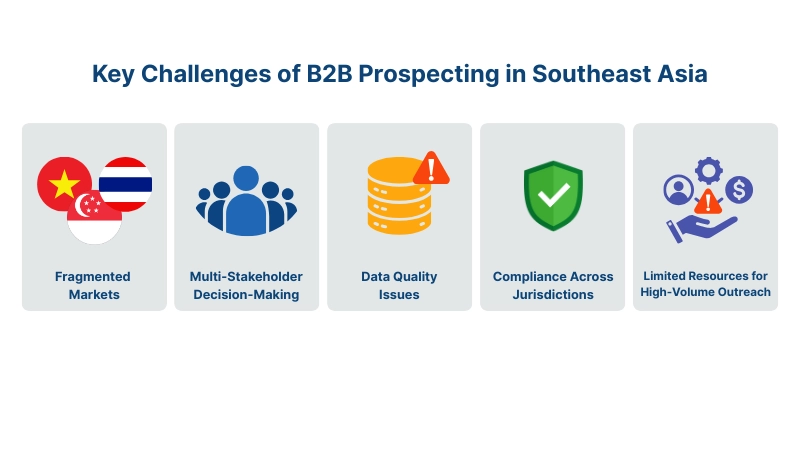
Key Challenges of B2B Prospecting in Southeast Asia
1. Fragmented Markets
Each country has unique languages, cultures, and business norms. A single campaign cannot effectively cover all countries. For example:
- In Singapore, business communication is typically direct and fast-paced.
- In Thailand, building relationships and trust plays a larger role before deals progress.
- In Vietnam, local networks often influence buying decisions.
2. Multi-Stakeholder Decision-Making
Especially in industries like technology, finance, and healthcare, decisions involve multiple people across technical, financial, and executive roles. This means sales cycles are longer and require tailored engagement.
3. Data Quality Issues
Accurate and verified prospect data is difficult to obtain. Businesses often face challenges with incomplete contact information, outdated records, and poor targeting. This lowers response rates and wastes resources.
4. Compliance Across Jurisdictions
Different countries enforce their own privacy and marketing rules. Examples include:
- Singapore’s Personal Data Protection Act (PDPA)
- Australia’s ACMA Do Not Call rules
- U.S. regulations, such as CAN-SPAM for email
Companies need to design campaigns that stay compliant across borders, which requires both legal awareness and operational discipline.
5. Limited Resources for High-Volume Outreach
Building an in-house sales development team requires significant investment in training, data tools, and technology. Many businesses lack the resources or regional expertise to manage this effectively.
Are you considering outsourcing? Discover 10 benefits of outsourcing lead generation when expanding into APAC.
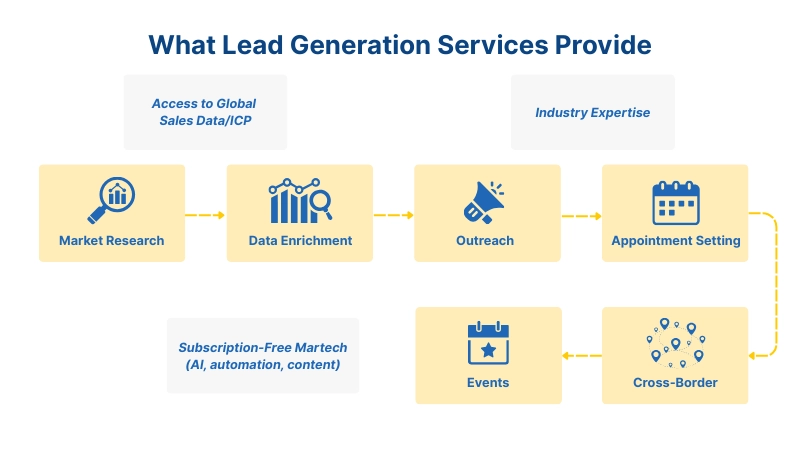
What Lead Generation Services Provide
Professional lead generation services in Southeast Asia fill these gaps by combining local knowledge, compliance practices, and multi-channel engagement. Typical services include:
Market Research and Prospecting
- Identifying companies that fit an ideal customer profile (ICP).
- Researching decision-makers, their roles, and purchasing responsibilities.
Access to Global Sales and Marketing Data
- Providers often maintain in-house databases covering millions of verified contacts.
- This access speeds up prospecting and helps businesses enter new markets with accurate, ready-to-use data.
Data Enrichment
- Updating prospect records with correct phone numbers, job titles, and emails.
- Removing duplicates or inactive contacts to improve accuracy.
Subscription-Free Access to Martech
- Businesses gain the benefits of advanced tools—automation, AI-driven analytics, CRM integration, and content platforms—without the cost of separate subscriptions.
- This ensures campaigns are data-driven, personalized, and measurable.
Multi-Channel Outreach
- Coordinating communication through phone, email, social channels, and events.
- Ensuring consistent touchpoints while respecting local preferences.
Appointment Setting
- Scheduling qualified meetings with prospects who have expressed interest or intent.
- Freeing internal sales teams to focus on closing deals instead of prospecting.
Explore 7 Appointment Setting Tips to Boost Sales Performance
Event Lead Generation
- Running pre-event campaigns to attract attendees.
- Following up after conferences or trade shows to convert interest into opportunities.
Cross-Border Campaigns
- Managing outreach across several ASEAN countries.
- Adapting to local languages and business practices for each market.
Industry Expertise
- Many agencies specialize in industries such as technology, healthcare, finance, manufacturing, and education.
- Specialized teams understand sector-specific buying journeys and decision-making processes, which shortens ramp-up time and improves outcomes.
These services create a structured system to generate and nurture opportunities across the region.
See how a Branding Consultancy Gained New Prospects and Event Attendees in SE Asia with Callbox.
Best Practices for Effective Lead Generation in Southeast Asia
1. Localize Messaging
Prospects respond better when communication feels tailored to their market. Localization goes beyond language—it includes adapting tone, references, and value propositions to cultural expectations.
2. Use Multi-Channel Engagement
Single-channel campaigns have limited impact. Combining phone, email, LinkedIn, and content improves visibility and credibility. For example, a call may be followed by a LinkedIn connection request and a personalized email.

3. Prioritize Compliance
Building compliance into every campaign safeguards trust. Examples include:
- Adding clear opt-out links in emails.
- Respecting local calling hours as outlined in telemarketing rules.
- Maintaining updated “do not call” lists to avoid unwanted outreach.
4. Maintain High Data Quality
Data accuracy directly impacts response rates. Continuous enrichment, validation, and segmentation keep campaigns efficient.
5. Apply Account-Based Marketing (ABM)
Instead of casting a wide net, ABM focuses on high-value accounts and decision-makers. This is especially effective in sectors with long sales cycles, such as enterprise technology or healthcare.
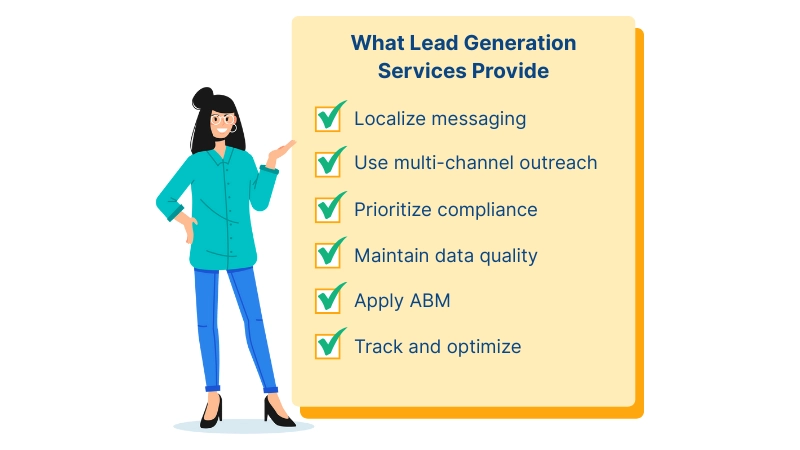
6. Track and Optimize
Measuring outcomes—response rates, appointment quality, and conversion ratios—ensures that strategies improve over time. Campaigns that are not regularly optimized lose effectiveness quickly.
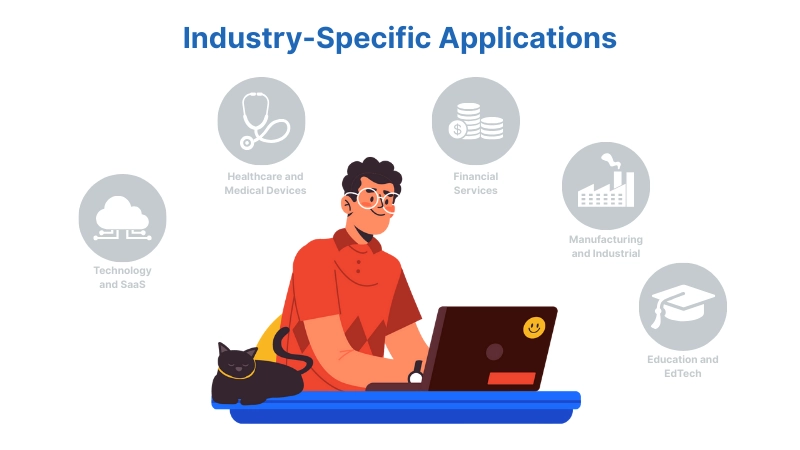
Industry-Specific Applications
Lead generation services are particularly valuable in these sectors:
Technology and SaaS
- Demand for cloud solutions, cybersecurity, and enterprise software is high.
- Decision-making often involves IT managers, finance leaders, and executives, making multi-stakeholder engagement necessary.
Learn why tech startups are turning to outsourced lead generation
Healthcare and Medical Devices
- Hospitals, labs, and diagnostic centers are investing in technology.
- Outreach must comply with privacy regulations while targeting decision-makers like procurement heads and administrators.
Financial Services
- Banks and fintech firms seek partnerships and technology providers.
- Compliance and trust are major factors in winning new clients.
Manufacturing and Industrial
- Export-oriented companies look for supply chain partners.
- Lead generation supports cross-border outreach and B2B matchmaking.
Education and EdTech
- Universities and training institutions seek to attract students, partners, and technology providers.
- Multi-channel campaigns, especially event-based, are effective in this sector.
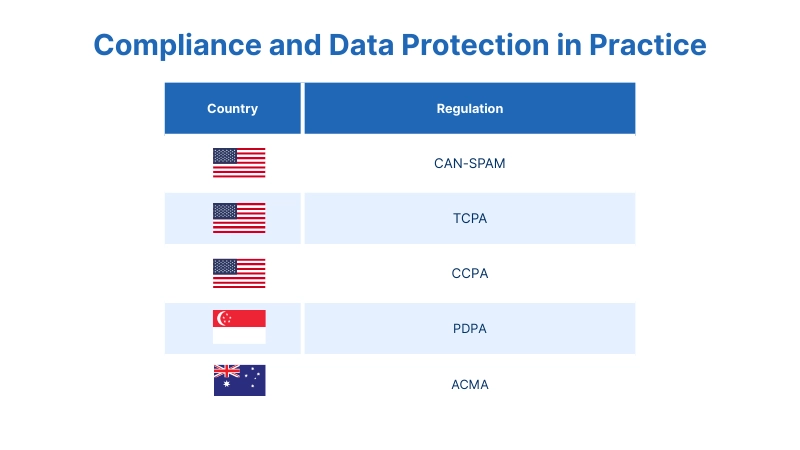
Compliance and Data Protection in Practice
Effective lead generation in Southeast Asia requires alignment with multiple laws and standards. Key examples include:
- CAN-SPAM Act: Clear subject lines, opt-out options, and valid sender details.
- Telephone Consumer Protection Act (TCPA): Restrictions on automated calls and calling hours.
- California Consumer Privacy Act (CCPA): Transparency in data collection and “Do Not Sell” options.
- Singapore PDPA: Consent required before collecting or using personal data.
- Australia ACMA: Do Not Call Register enforcement and calling time limits.
Agencies that integrate compliance from the start reduce risks for businesses and enhance credibility with prospects.
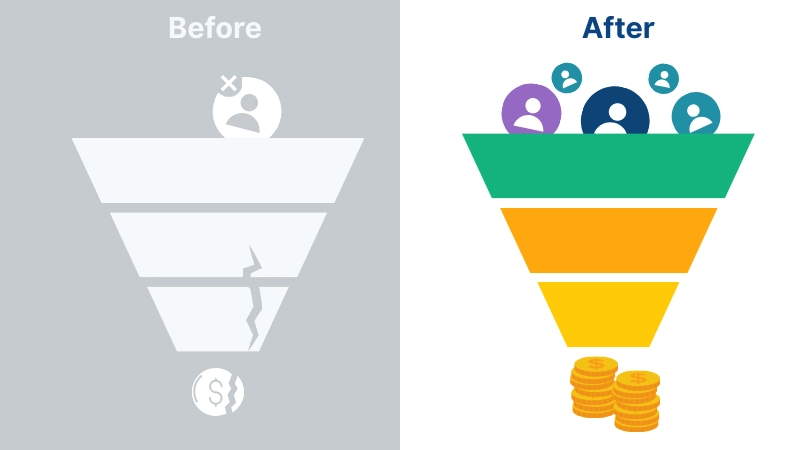
Measuring the Impact of Lead Generation Services
When companies use structured lead generation, they see tangible outcomes:
- Faster Market Entry: Local expertise speeds up access to the right decision-makers.
- Improved Conversion Rates: Verified data and tailored engagement reduce wasted outreach.
- Shorter Sales Cycles: Sales teams engage with leads already qualified and interested.
- Efficient Resource Use: Internal teams focus on negotiations and closing rather than cold outreach.
- Sustainable Growth: Continuous pipeline development supports long-term business expansion.
Final Thoughts
Southeast Asia is a region full of opportunity, but it requires the right strategy to succeed. Diverse markets, long buying cycles, and regulatory differences make prospecting complex. Businesses that invest in lead generation services in Southeast Asia gain an advantage by applying local expertise, compliant practices, and multi-channel engagement.
Whether entering Singapore, Vietnam, Thailand, Malaysia, or the Philippines, the ability to connect with the right decision-makers is key. Lead generation partners that combine accurate data, cultural knowledge, and structured outreach provide the foundation for long-term growth.