






As more companies move away from legacy hardware and adopt cloud-based platforms, vendors are facing both an opportunity and a challenge in Singapore and the broader APAC region.
The global cloud computing market is expected to grow from $371.4 billion in 2020 to $832.1 billion by 2025. Despite this rapid growth, cloud adoption remains in its early stages for many organisations, especially in B2B.
Providers need to do more than just sell a product; they need to position themselves as trusted advisors. That is why more companies are turning to lead generation services for cloud service providers to boost visibility and drive real conversations.
In this blog, we explore what cloud-based solutions are, the main challenges vendors face, and key strategies to help cloud companies generate leads for cloud solutions, improve conversion, and scale with effective marketing cloud solutions and sales techniques.
What Are Cloud-Based Solutions?

Cloud-based solutions refer to software, platforms, or infrastructure that are hosted remotely and accessed over the internet. On a pay-as-you-use model, these services offer scalability, cost control, and operational flexibility. The three primary models are:
- IaaS (Infrastructure-as-a-Service): Virtualised hardware such as storage, networking, and servers.
- PaaS (Platform-as-a-Service): A framework for developers to build, test, and manage applications.
- SaaS (Software-as-a-Service): Hosted software accessible via browser or app.
With cloud-based infrastructure becoming mainstream, providers must adopt smarter marketing strategies for cloud providers to stand out and demonstrate value.
Understanding the Cloud Buyer
The biggest challenge in marketing cloud services is education. Many decision-makers lack a full understanding of cloud technology and need help connecting its features to business value.
Sales teams must bridge this gap with simplified messaging and use cases that speak to outcomes. In B2B marketing for cloud software, personalization and relevance matter more than jargon or specs. Providers must shift the conversation from “what it does” to “how it solves a problem.”
Addressing Security Concerns
Security is often the biggest roadblock. More than half of IT leaders believe on-premises systems are safer than the cloud. This presents a challenge for anyone selling cloud computing services in regulated industries like healthcare and finance.
Rather than brushing off concerns, vendors should lead with transparency. Offer proof points such as encryption protocols, compliance certifications, and access control frameworks. These build trust and move leads closer to becoming sales-qualified leads (SQLs).
Looking to grow your cloud customer base in APAC?
High-Impact Strategies for Selling Cloud Services

1. Start Small and Build Trust
Introduce small, value-driven solutions to help clients realize ROI quickly. Many organizations not “born in the cloud” struggle with large-scale migration. By offering lightweight implementation or starter packages, you reduce risk and lower the entry barrier.
This is a practical tactic in marketing for IaaS/PaaS/SaaS providers, especially for first-time adopters.
2. Speak the Customer’s Language
Use simple language that your audience understands. Avoid technical jargon and speak in terms they use. Ask questions about their current systems, challenges, and goals. Focus on having a conversation instead of giving a sales pitch. Make sure your message is easy to follow, even for non-technical decision-makers.
This approach is an important part of account-based marketing. It involves adjusting your message to match the specific needs of each company and role.
3. Position Yourself as an Innovation Partner
Buyers want partners, not vendors. Position yourself as a strategic ally who can guide their digital transformation. Content-driven marketing, such as thought leadership blogs, webinars, and case studies, helps reinforce your authority.
Cloud solutions marketing services that focus on education tend to convert better because they create long-term value, not just one-time sales.
4. Engage Multiple Stakeholders
Decisions about cloud services often involve cross-functional input—from IT, finance, operations, and security. Build relationships across levels and departments. Involve your sales and marketing teams in ABM programs to personalize engagement at every stage of the buying journey.
Use email marketing automation and lead nurturing workflows to support this effort over time.
Explore 4 Solid B2B Email Campaign Ideas to Market Cloud Solutions
5. Tie Solutions to Business Impact
Always link your offer to business results: improved workflows, lower costs, better collaboration, and reduced downtime. This is especially important when speaking to non-technical buyers who care more about outcomes than architecture.
Framing your messaging around business impact is one of the core pillars of successful marketing cloud solutions.
6. Be Proactive About Security
Address security early. Highlight your certifications, offer data compliance checklists, and explain how your infrastructure meets standards. If your buyers trust you to protect their data, they will trust you to drive their business forward.
Get qualified leads ready for sales conversations.
Advanced Techniques to Win More Cloud Deals
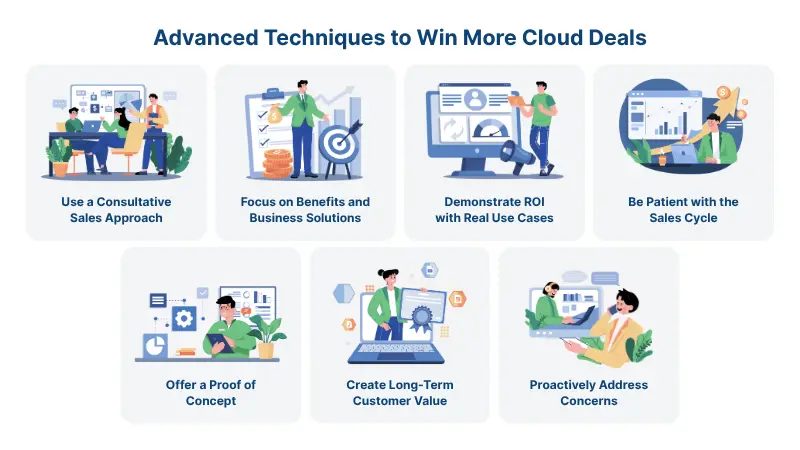
To further boost visibility, trust, and conversion rates, here are seven additional techniques every cloud service provider should apply.
1. Use a Consultative Sales Approach
Guide the buyer. Listen actively and design solutions tailored to their needs.
2. Focus on Benefits and Business Solutions
Show how your services improve security, cut costs, and streamline operations. Use stories and results, not features.
3. Demonstrate ROI with Real Use Cases
Especially for SaaS, present ROI metrics and explain how your cloud-based infrastructure delivers measurable business gains.
4. Be Patient with the Sales Cycle
B2B sales for cloud are often slow. Support your claims with testimonials, data sheets, and follow-up materials to build trust.
5. Offer a Proof of Concept
Run a pilot project or short-term engagement to let prospects see your product in action. This builds credibility and reduces buyer hesitation.
6. Create Long-Term Customer Value
Focus on customer lifetime value. Offer ongoing support, training, and upgrades. This helps build loyal clients and strong referrals.
7. Proactively Address Concerns
Anticipate objections and answer them before they arise. Whether about compliance, downtime, or cost, transparency builds confidence.
Discover how Callbox drives market expansion for a hyperscale cloud provider in Australia
Conclusion: Turning Strategy into Success
Selling cloud solutions is not just about advanced technology. It is about helping buyers understand the value, building trust, and guiding them at every step. As competition grows and buyer needs change, cloud providers need a clear strategy.
Understand your audience, answer their concerns, and reach out through multiple personalized channels. This helps you build stronger connections and gain more clients. Whether you want to promote your services, get qualified leads, or support account-based marketing, success comes from clear messaging, a focus on the customer, and steady follow-up.
With the right tactics in place, your cloud services will not just compete in a crowded market, but rather lead it.